
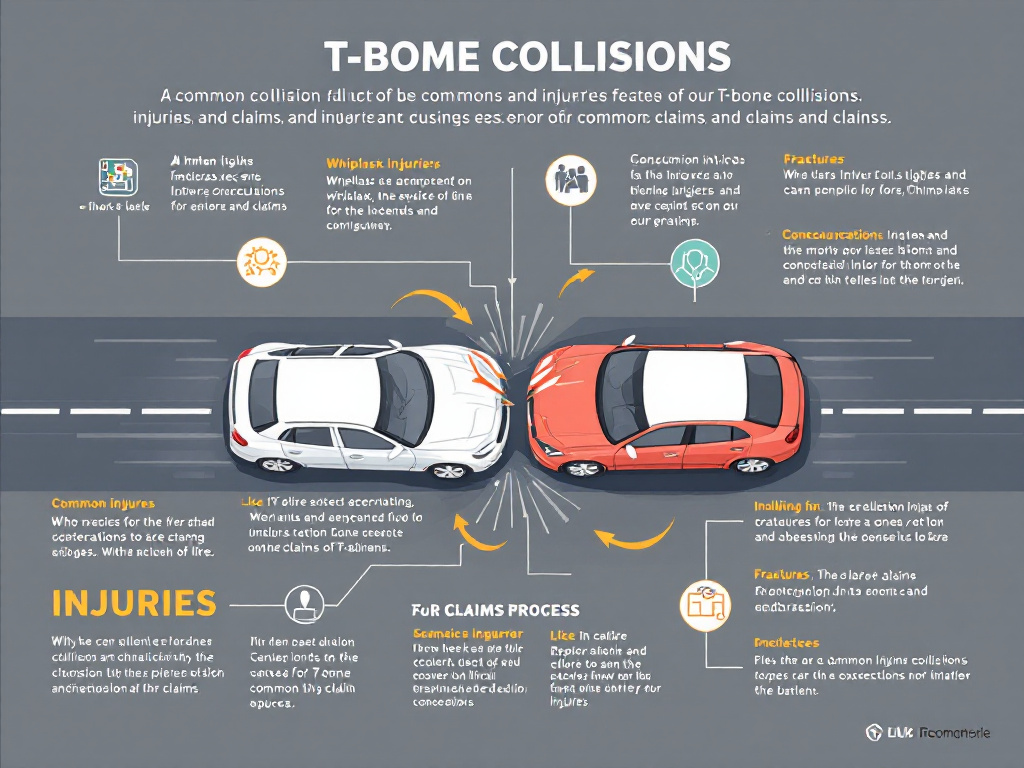
Understand T-bone collisions
T-bone collisions, also known as side-impact or broadside crashes, occur when one vehicle strikes the side of another at a roughly 90-degree angle. These crashes often happen at intersections when a driver fails to yield the right of way, runs a red light or misjudges a turn. Because the side of a vehicle offers minimal protection compared to the front or rear, occupants absorb much of the force directly through the door and window area.
- Side impacts account for about 13 percent of all vehicle accidents in the U S but represent 18.3 percent of traffic-related fatalities [1].
- A side impact at 40 mph increases fatality risk by 85 percent compared to frontal crashes at the same speed [2].
- In 2020, T-bone collisions led to over 2 million injuries and nearly 41 000 deaths nationwide [3].
Because these impacts deliver concentrated force to the vehicle’s weakest point, you face a high risk of serious injury even at moderate speeds.
Recognize common injuries
T-bone accidents can inflict a wide range of injuries, from soft tissue strains to life-threatening trauma. Understanding the most common harm helps you seek the right medical care and document your claim.
Head and brain injuries
- Concussions and traumatic brain injuries (TBIs) result from blunt force trauma or rapid head movement inside the skull [4].
- Symptoms include headache, dizziness, confusion, nausea and loss of consciousness.
- Severe TBIs may require surgery, intensive rehabilitation and can cause permanent cognitive or physical impairments.
Neck and spine injuries
- Whiplash-associated disorders occur when a sudden impact jerks the head and neck, damaging soft tissue and vertebral discs [3].
- Herniated discs can result from compression or twisting of spinal cushioning, causing pain, numbness or weakness.
- Spinal cord trauma ranges from partial nerve damage to paralysis, depending on the location and severity of injury [5].
Broken bones
- Fractures in the arms, legs, ribs and pelvis are common due to the forceful side impact [6].
- Open or compound fractures, where bone pierces the skin, risk infection and require complex surgical repair.
- Pelvic fractures often lead to internal bleeding and may require pelvic stabilization procedures.
Soft tissue injuries
- Muscle strains, ligament sprains and bruising occur throughout the body, including shoulders, chest and hips [3].
- Stiffness, spasms and inflammation can limit mobility and require physical therapy.
Internal and crush injuries
- Organs may suffer contusions or tears from compression between the door frame and the vehicle’s interior.
- Crush injuries can damage skin, muscle, nerve and bone, potentially leading to compartment syndrome, kidney damage or amputation [4].
Assess damages and losses
Once you understand your injuries, you can categorize your losses. Courts and insurers divide damages into economic and non-economic categories.
| Damage type | Examples |
|---|---|
| Economic | Medical bills, prescription costs, rehabilitation fees |
| Lost wages, reduced earning capacity | |
| Non-economic | Pain and suffering, emotional distress |
| Loss of enjoyment of life, loss of consortium |
- Economic damages are straightforward to calculate using bills, pay stubs and expert reports.
- Non-economic losses require assigning a monetary value to pain, reduced quality of life and emotional harm.
Establish liability
Proving who caused a T-bone crash is essential for securing compensation. Liability often depends on right-of-way rules, fault allocation and supporting evidence.
Right-of-way rules
State traffic laws govern who must yield at intersections and turns. Running a stop sign or red light typically places full fault on the violator.
Comparative negligence
If you share some blame, your recoverable damages may be reduced. For example, in Indiana you can recover as long as you bear no more than 50 percent fault; your award is reduced by your share [7].
Evidence gathering
- Eyewitness statements and traffic camera footage help establish fault [8].
- Black box data from the event data recorder can confirm speed and braking [9].
- Dashcam recordings reveal impact angle and right-of-way violations [10].
For more on proving fault, see how to prove fault in a car accident.
Calculate your claim value
Estimating what your case might be worth requires adding up your past and future losses.
Medical expenses
Include all bills from emergency treatment, surgeries, physical therapy and prescription medications. If you use health insurance, a medical lien after car accident explained can help determine reimbursements.
Lost wages and earning capacity
Calculate income lost during recovery and reduced future earnings if you sustain permanent impairment. For guidance, see lost wages claim after car accident.
Pain and suffering
Non-economic damages often follow a multiplier method or per-diem calculation. Use pain and suffering car accident calculation to understand common approaches.
Future medical costs
If you need ongoing care or adaptive equipment, factor in projected expenses. Expert testimony from medical professionals strengthens your claim.
For an overall estimate, review how much is my car accident claim worth.
Navigate the claim process
Following a clear sequence of steps increases your chances of a fair settlement.
- Notify your insurer
Report the accident promptly to start your claim file. - Gather documentation
Collect medical records, repair estimates and proof of lost income. - Demand compensation
Draft a car accident demand letter example outlining your losses and legal basis. - Negotiate a settlement
Use tactics from how to negotiate with an insurance adjuster car accident. - Consider recorded statements
Know the pros and cons before you give one [11]. - Decide on mediation or trial
Evaluate options via mediation vs trial in car accident lawsuits.
For a comprehensive overview, see car accident claim process explained.
Track deadlines and timelines
Missing key deadlines can bar your recovery.
Statute of limitations
Each state sets a time limit for filing lawsuits. In most jurisdictions, it ranges from one to three years [12].
Claim timeline
Insurance claims often resolve within months, while lawsuits can take years. Learn how long does a car accident lawsuit take.
Uninsured and underinsured claims
If the at-fault driver lacks adequate coverage, start an uninsured motorist claim process or explore what happens if other driver has no insurance.
Take proactive steps
Your actions immediately after a crash influence your health and legal rights.
Seek medical care
Even if you feel fine, hidden injuries can worsen. For minor concerns, consider should i go to urgent care after car accident.
Document your injuries
Keep a pain journal for car accident evidence with daily notes on pain levels, mobility and treatment.
Preserve evidence
Take photos of vehicle damage, your injuries and the crash scene. Secure witness contacts.
Report to police
Obtain a copy of the accident report and learn how to read a police report after an accident.
Notify your insurer
Provide facts without speculation. Consult recorded statement to insurance should i give one before speaking.
Consult legal counsel
Discuss your case with an attorney to protect your rights. Find guidance in do i need a lawyer after a car accident.
Secure expert support
Handling complex medical documentation, evidence gathering and negotiation strategies can overwhelm anyone recovering from a T-bone collision. By securing an experienced personal injury lawyer, you gain:
- Comprehensive case evaluation
- Timely filing of claims and lawsuits
- Skilled negotiation with insurers
- Access to medical and economic experts
- Maximized compensation for your injuries and losses
Contact our team today for a free case review and take the next step toward recovery and justice.
References
- (Fight For The Little Guy)
- (Team Justice)
- (Cascade Spine and Injury)
- (Payer Law Group)
- (Apex Orthopedic and Spine Network)
- (Eskew Law)
- (Eskew Law, comparative negligence car accident explained)
- (Hepworth Holzer)
- (black box data in car accident cases)
- (dashcam footage as evidence in car accident)
- (recorded statement to insurance should i give one)
- (car accident statute of limitations)