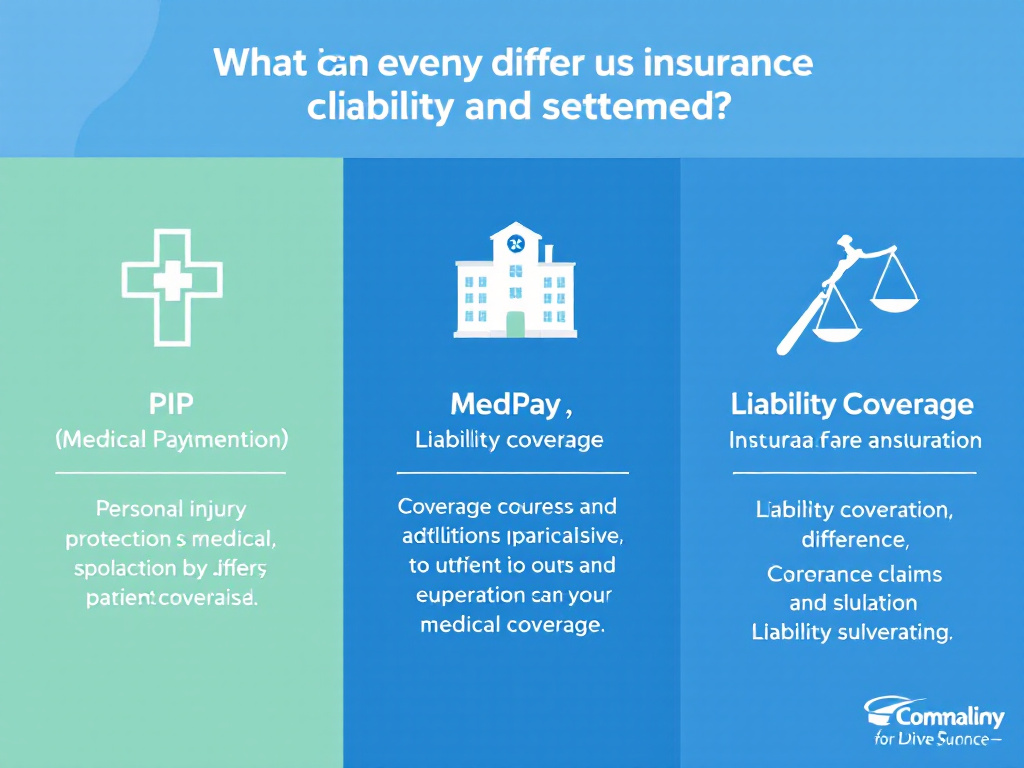
Get clarity on PIP vs MedPay vs liability coverage explained so you know which protection applies when you, your passengers, or others suffer injuries in a crash. Understanding the differences between personal injury protection, medical payments coverage, and liability insurance can help you make informed choices, file the right claims, and avoid gaps in coverage after an accident. In this guide, you’ll find definitions, comparisons, state requirements, cost insights, claim-filing steps, and tips on choosing the right mix for your needs.
Personal injury protection
Coverage overview
Personal injury protection (PIP) is a no-fault auto insurance component that covers your expenses after a wreck, regardless of who caused it. Typical benefits include:
- Medical bills for you and covered passengers, including doctor visits, hospital stays, physical and occupational therapy, psychiatric services, and rehabilitation [1]
- Lost wages, often up to 80 percent of your salary, when injuries prevent you from working
- Non-medical services such as child care, housekeeping, and funeral expenses
- Death benefits for survivors
PIP policies vary by state. Limits can range from $2,500 up to unlimited medical expenses and permanent injury benefits of $250,000 [2]. In states with compulsory PIP—like Florida, Michigan, New Jersey, New York, Pennsylvania, Delaware, and Oregon—you must carry this coverage.
Filing a PIP claim
- Seek medical attention immediately and save all bills, receipts, and therapist notes.
- Notify your insurer in writing or via your insurer’s online portal.
- Complete any required claim forms, attaching itemized medical statements and proof of lost wages.
- Submit documentation for non-medical expenses, such as childcare or housekeeping.
- Track claim status and follow up if you encounter delays.
For a detailed walkthrough of post-accident steps, see car accident claim process explained.
Medical payments coverage
Coverage overview
Medical payments coverage, often called MedPay or Med-Pay, is an optional add-on that pays for reasonable medical costs after a crash, regardless of fault. Key features:
- Covers medical expenses for you, your residents, and your passengers, typically up to a per-person limit of $5,000–$10,000 [3].
- Includes ambulance fees, dental care, chiropractic visits, funeral expenses, and hospital bills without requiring a deductible or copay.
- Does not cover lost wages, non-medical services, or death benefits.
- Optional in most states; mandatory only in Maine, New Hampshire, and Pennsylvania [1].
MedPay premiums are relatively low, often $5–$30 per year, making it an affordable supplement for those with high-deductible health plans.
Subrogation and reimbursement
Unlike PIP, MedPay policies allow insurers to recover payments from an at-fault party through subrogation. If you later receive compensation from the other driver’s liability coverage, your insurer may require you to reimburse MedPay benefits. However, if your third-party settlement leaves you under-compensated, your attorney can argue you were not made whole and fight to reduce or eliminate repayment obligations [4].
Liability coverage basics
Bodily injury liability
Bodily injury liability covers medical expenses, lost wages, and legal fees of others when you’re at fault in an accident. It does not protect your injuries—only those of the injured third parties. Typical limits are noted as two figures, for example 100/300, meaning $100,000 per person and $300,000 per accident.
Property damage liability
Property damage liability pays for repairs or replacement of other people’s property—vehicles, fences, buildings—when you cause an accident. Common limits start at $25,000 per incident but can be higher depending on your state’s minimum requirements.
Liability coverage is mandatory in every state. Minimum limits vary, but carrying higher limits can protect you from out-of-pocket costs if damages exceed your policy caps.
Compare coverage options
| Coverage type | Who it covers | What it covers | Subrogation | Mandatory states | Typical limits |
|---|---|---|---|---|---|
| PIP | You, passengers, resident relatives | Medical care, lost wages, non-medical services, death | No | FL, MI, NJ, NY, PA, DE, OR | $2,500–unlimited medical |
| MedPay | You, passengers, resident relatives | Medical expenses only | Yes | ME, NH, PA | $5,000–$10,000 per person |
| Bodily injury | Injured third parties | Third-party medical bills, lost wages, legal expenses | N/A | All states | State minimum—e.g. $25k/$50k |
| Property damage | Damaged property owners | Vehicle, fence, building repairs | N/A | All states | State minimum—e.g. $10k–$25k |
This table highlights how each coverage type serves a distinct purpose. You may carry both PIP and MedPay in states where PIP is optional to maximize your medical protections.
State requirements and costs
Mandatory coverage by state
- PIP required in no-fault states such as Florida, Michigan, New Jersey, New York, Pennsylvania, Delaware, and Oregon
- MedPay compulsory only in Maine, New Hampshire, and Pennsylvania
- Liability coverage mandatory nationwide, with state-specific minimum limits
Premium estimates
- Adding MedPay can increase your premium by roughly $5–$30 per year [5]
- PIP coverage often raises auto insurance rates by 15–20 percent, varying by state [1]
- Liability costs depend on your driving record, location, vehicle type, and chosen limits
Choosing your coverage mix
Weigh your existing health insurance
If you have a robust health plan with low deductibles, you might rely on it for initial medical bills and use MedPay for copays and deductibles. In no-fault states, PIP often coordinates with your health insurance, covering expenses your primary plan does not [6]. Learn more about coordinating coverage in using health insurance after a car accident.
Assess your risk tolerance and budget
- If you prefer minimal out-of-pocket risk, a combination of PIP and MedPay can cover most accident-related costs
- Budget-minded drivers may opt for only PIP in mandatory states and skip MedPay
- In tort states without PIP requirements, MedPay can bridge high deductible gaps
Consider your state rules
Understanding local regulations helps you avoid redundant coverage and wasted premiums. In no-fault states, MedPay may duplicate PIP benefits. In tort states, MedPay can be your primary accident medical coverage.
Accident claim process
Immediate actions
- Call 911 and seek medical care, even for minor injuries
- Gather driver information, witness contacts, and photos of the scene
- Report the crash to police and obtain a copy of the report [7]
- Notify your insurer promptly
Filing your coverages
- Submit PIP and MedPay claims to your insurer with itemized bills and medical records
- If another driver is at fault, file a liability claim with their insurer
- Keep copies of all correspondence and follow up on unpaid claims
Determining fault and value
Fault influences which coverage pays first and how much you’ll recover. In some states, comparative negligence reduces your claim if you share blame [8]. To estimate your case value—including pain and suffering—see pain and suffering car accident calculation and how much is my car accident claim worth.
Settlement and timeline
- PIP and MedPay claims usually resolve within weeks if documentation is complete
- Third-party liability claims can take months, depending on dispute and negotiations [9]
- File your lawsuit before the deadline—your state’s statute of limitations [10]
Get legal help
When to call a lawyer
You may benefit from legal guidance if:
- Your insurer denies or underpays your PIP or MedPay claim
- Liability is disputed and you need help proving fault [11]
- You face serious injuries, high medical bills, or complex liability exposures
For more on whether you need representation, read do i need a lawyer after a car accident.
Free case review
Our experienced personal injury attorneys can review your policy, claims, and accident details at no cost. Contact us today for a free case evaluation and ensure you receive the compensation you deserve.
By understanding PIP, MedPay, and liability coverage basics, you can select the right protections, file claims correctly, and pursue full recovery after a crash. If you have questions about your auto policy or need assistance with your claim, reach out for expert guidance.
References
- (Infinity Auto)
- (Shiner Law Group)
- (Bankrate)
- (Ashmore Law & Associates)
- (Tivly)
- (GEICO)
- (how to read a police report after an accident)
- (comparative negligence car accident explained)
- (how long does a car accident lawsuit take)
- (car accident statute of limitations)
- (how to prove fault in a car accident)