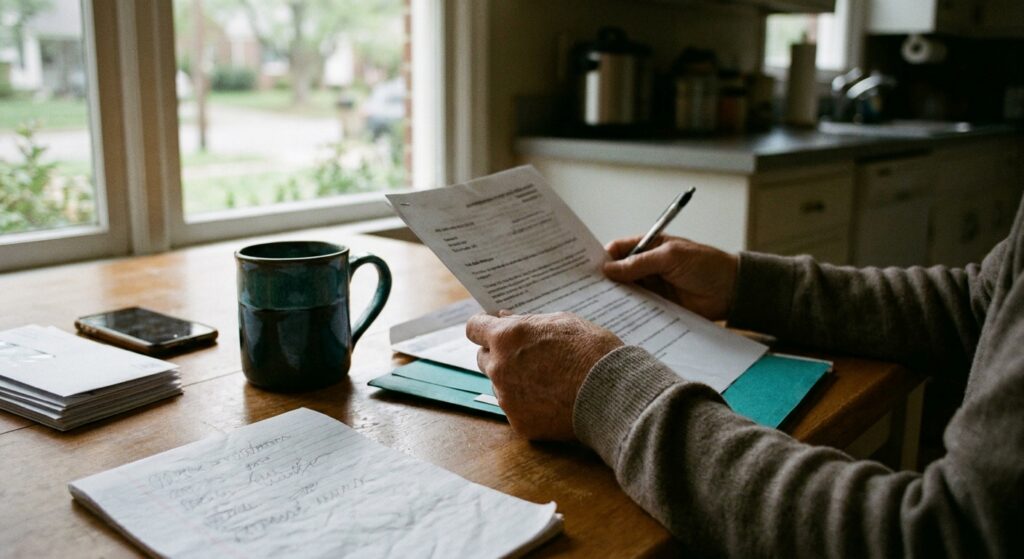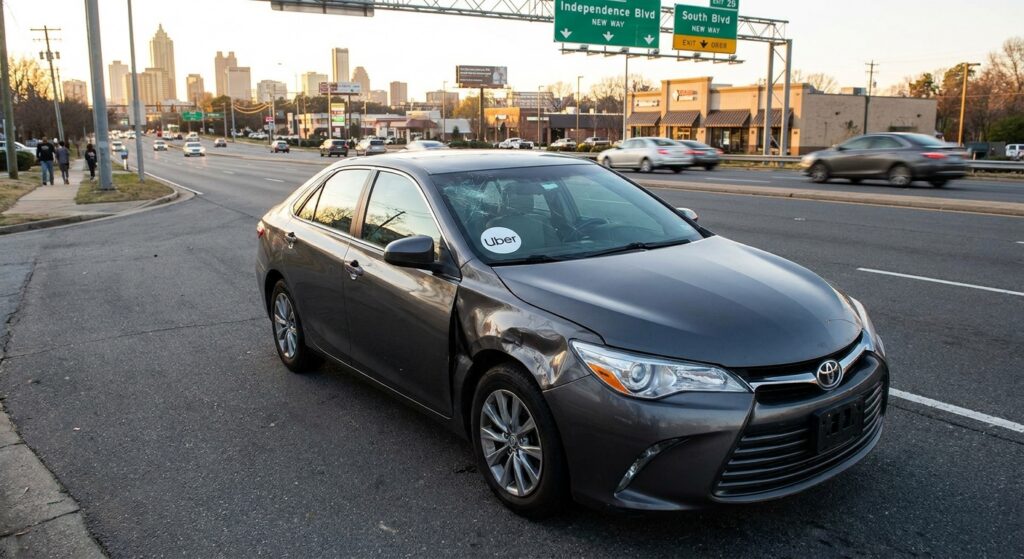
The adjuster called about your car before you even left the tow lot. She was friendly and apologetic, eager to get things moving, and then she asked if you had a minute to give a recorded statement about what happened. You said yes because you were telling the truth and had nothing to hide. That choice felt cooperative and harmless. Yet it is a pattern I see when Charlotte accident victims come to Carma Legal after trying to handle things themselves: the car side went fine, and the bodily injury claim took the damage. So before you search for a property damage claim lawyer, it helps to know what that lawyer is really protecting, because it is usually not the car.
I would rather give you honest guidance than sell you something you do not need. Some people can get through the vehicle side of a crash on their own. The real risk is the recorded phone call that rides along with it. Carma Legal serves injured people in Charlotte, and this guide covers North Carolina rules and how property damage claims play out after a not-at-fault wreck here. By the end, you will know when to handle the car yourself, when to call an attorney, and what to ask before you hire anyone.
Why Some Charlotte Accident Victims Can Handle Property Damage Claims on Their Own
Some people can handle their own property damage claim because the payout follows a formula, not a negotiation. If your car can be repaired, it goes to a shop and gets fixed on the insurance company’s dime. If it is a total loss, you are paid the market value of the vehicle.
People sometimes ask Carma Legal how the final car settlement compares to the insurer’s first offer. There is no single figure to give, because everything turns on what happened to the car. A repairable vehicle goes to the shop, comes back fixed, and there is no claim left to fight over. A totaled vehicle is paid at what that car would bring on the market, and the calculation is close to formulaic. On the vehicle alone, there is no “first offer versus final number” story. The car is worth what it is worth.
So what does a property damage claim actually cover after a not-at-fault accident in North Carolina? It covers the cost to repair your vehicle to its pre-accident condition. If repairs would cost more than the car is worth, it covers the fair market value of the car at the time of the crash. North Carolina requires drivers to carry property damage liability coverage under N.C. Gen. Stat. § 20-279.21, and that coverage pays for your car when the other driver caused the wreck. Depending on the policy and the facts, the claim can also include a rental car or loss of use while your car is out of service, personal items in the car that were damaged in the crash, and in some cases diminished value, which is the drop in resale value a car can suffer even after a good repair. You can also run the repair through your own collision coverage and let your insurer go after the at-fault driver’s company. That route can be faster if the other insurer is dragging its feet.
None of that requires a courtroom. A claim for property damage comes down to a simple question: what was damaged, and what does it take to make it right? When the number comes from a shop estimate or market data, a lawyer may have little to add on the car by itself. If a total-loss offer looks low, you can push back on your own by sending the adjuster listings for comparable vehicles with similar mileage, trim, and condition.
The Real Trap: How Adjusters Use Property Damage Conversations to Damage Your Injury Claim
If the car itself is rarely the problem, where does the danger come from? It is not the repair estimate. It is the recorded call where the adjuster moves from your bumper to how the crash happened and how you are feeling.
When people manage their own property damage claim and then come to Carma Legal, the vehicle is not always what went wrong. They sometimes handle that part reasonably well, and it is not what worries me. What worries me is what got said along the way. In some of these cases, the person shared more than necessary about how the accident occurred and about their injuries. They were put on a recorded line, or said things over the phone that hurt their bodily injury claim. They were not being dishonest. They were boxed in by someone trained to mitigate damages, to deny, to delay, and to make you look at fault when you are not.
Picture how it sounds in real life. The adjuster is warm and says she just needs a few details to get the repair moving. Then the questions start. How fast were you going? Did you see the other car before it pulled out? Were you looking at your phone? How are you feeling today? You answer honestly, but you are tired, sore, and still rattled. “I think I was going about the speed limit.” “I didn’t really see him until the last second.” “I’m okay, just a little stiff.” Every one of those answers is now on a recording, and every one can be read back to you later in a way that sounds very different from what you meant.
This matters more in North Carolina than almost anywhere else. North Carolina follows contributory negligence, a rule only a small handful of states still use. Under that rule, if the insurer can show you were even partly at fault, it can argue you should recover nothing for your injuries. That is why an adjuster wants to hear you say you “didn’t see” the other car or “might have” been going a little fast. Those words have little to do with your repair bill and everything to do with the injury claim that comes next.
You should also know that you are generally not required to give a recorded statement to the other driver’s insurance company. Your own policy may require you to cooperate with your own insurer, so read it, and talk to an attorney before you get on any recorded line about how the crash happened.
When Does a Property Damage Claim Lawyer Become Necessary, and Worth the Cost?
A property damage claim lawyer may become necessary when the adjuster’s behavior changes, and especially when you were hurt in the crash. Denials, delays, lowball offers, and pressure for a recorded statement can be signs the insurer is building a case against you, not just processing a repair.
Here is when you should stop handling it yourself and call an attorney:
- Your property damage claim was denied, or the adjuster says fault is “still under review” when the facts look clear to you.
- Payment is delayed with no clear reason, and you keep getting promised a call back that never comes.
- You received a lowball offer on a totaled car that does not match what similar cars sell for, and the adjuster will not explain the valuation.
- The adjuster is stonewalling your rental, leaving you without a way to get to work or to your doctor.
- The adjuster asked for a recorded statement or asked you to walk through how the accident happened.
- Policy language is being used against you, such as an exclusion or coverage question you do not understand.
- You were injured, even if the pain seemed minor at the scene.
People often ask Carma Legal what dollar amount of vehicle damage makes hiring an attorney worthwhile. That question misses the point. The claim worth protecting is the bodily injury claim. Property damage plays a part in it, but it is not the end all be all. A small repair and a total loss can both come with an injury, medical bills, and an adjuster looking for a reason to pay less.
When an adjuster stonewalls a rental, disputes liability on the property damage claim, or undervalues a totaled vehicle, it can signal the insurer is also setting up to deny or minimize the bodily injury claim that follows. The property damage dispute is the symptom, not the disease.
How Much Does a Property Damage Lawyer Cost?
Carma Legal does not take property damage claims by themselves, so any fee discussion is about the injury claim, not your car. If your only loss is the vehicle, the guidance is often that you may not need to pay a lawyer at all.
When I am asked what I charge to represent someone on property damage alone, the answer is that I do not handle property damage claims unless the bodily injury portion is attached. That is a deliberate choice, and it protects you. Paying a lawyer to collect a formulaic payout on a car may make little sense, and I would rather tell you that up front than take on work you can do yourself.
When you were hurt, the conversation changes, because the part of your claim at risk is no longer formulaic. That is the point to call, ask directly how fees are structured, and get clear communication about what you would owe before you commit to anything.
North Carolina’s Rules of Professional Conduct, adopted by the North Carolina State Bar, require contingency fee agreements to be in writing and to explain how the fee is calculated. Before you sign with any firm, make sure the agreement spells out the percentage, how case costs (such as medical records, filing fees, and expert fees) are handled, and what you owe if there is no recovery. If anything is unclear, ask. A firm that cannot explain its own fee agreement in plain language may not explain your case to you either.
How Much Does a Property Damage Attorney Cost?
The fee on paper is only part of the cost question. The bigger cost is what you may lose by handling the adjuster alone when you were also injured.
Think about where the real money in your claim sits. The car is paid by formula. Your medical bills, lost wages, and pain and suffering are not. Those depend on proof of causation (that the crash caused your injuries), proof of how serious the injuries are, and proof that you were not at fault. A single recorded call in the first week can weaken all three. An adjuster who gets you to say “I’m fine” on day two can point to it when you start physical therapy on day ten. An adjuster who gets you to say “I didn’t see him” can use it to argue fault under North Carolina’s contributory negligence rule.
That is the hidden price of going it alone, and it never shows up on a fee agreement. You will not get a bill for it. You will simply see a smaller offer later, or a denial letter that quotes your own words back to you.
So when you compare costs, compare the right things. On one side is the attorney’s fee. On the other is the risk of handing the insurer the statement it needs to pay you less. When you meet with any attorney, ask three questions: Who will actually handle my case day to day? How will you deal with the property damage adjuster so I do not have to? What happens to the fee if we recover nothing? The answers will tell you more about cost than any percentage.
Why Carma Legal Does Not Take Property Damage Cases Alone (and What That Tells You About Your Claim)
Carma Legal does not take property-only cases because the car is rarely where you need a lawyer. Instead, Carma Legal guides clients through their property damage claims as part of protecting the bodily injury portion, which is where the legal help may actually matter.
Some clients can work through the vehicle claim without me, and that is fine. The problem is that the adjuster blends the two together. The car conversation and the injury claim get treated as one, and whatever you said while sorting out your vehicle becomes material the adjuster uses on the injury side to mitigate damages or deny the claim outright. When Carma Legal steps in, I take over those adjuster conversations so the property damage process stops being a back door into your injury claim.
Someone once asked me how I handle a case involving both vehicle damage and injuries from the same wreck. Many clients have both. A crash forceful enough to hurt you is forceful enough to damage your car, so treating them as separate legal problems makes no sense.
North Carolina law does allow attorneys to represent clients on property damage claims by themselves, and some firms take them. At Carma Legal, the property damage work is handled as part of the full accident claim, because splitting the two only helps the insurer. I manage every aspect of each case myself, which means I know my client’s story from the moment the car was hit to the last doctor’s visit.
What Evidence Do You Need to Support Your Property Damage Claim?
For the car itself, Carma Legal keeps it simple: you need photos of the damage and, most likely, an inspection of the vehicle. The harder part is protecting yourself once the adjuster starts asking about fault and injuries.
People sometimes expect a long list of overlooked receipts and records. For the car, there is no secret list. Here is what you need and what to keep:
- Photos of the damage to the car, taken from several angles, including close-ups and wide shots that show where the impact was.
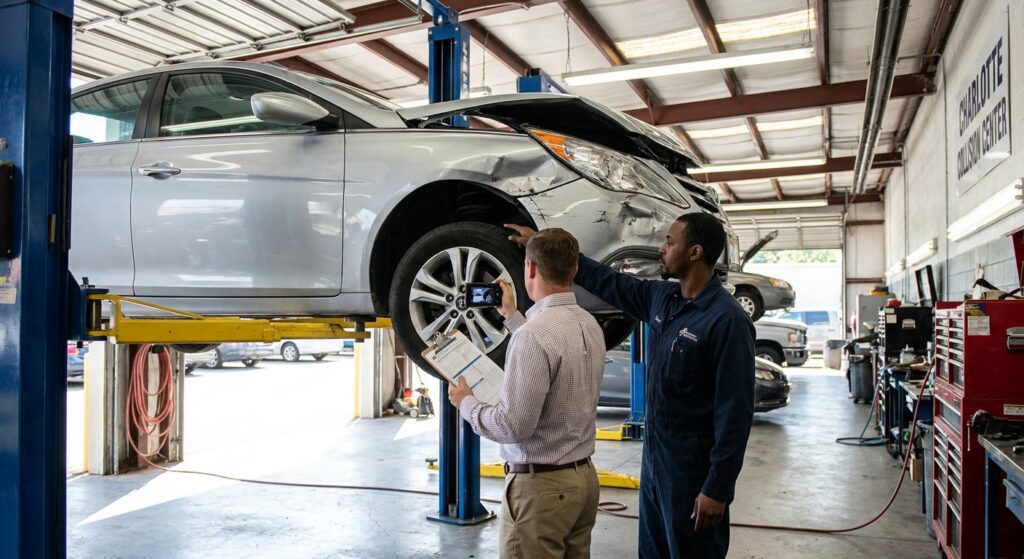
- An inspection of the vehicle, by the insurer’s appraiser or a body shop, which produces the repair estimate or the total-loss decision.
- The paperwork that inspection creates, such as the repair estimate, the final repair bill, or the total-loss valuation report, so you can check the numbers.
- Rental receipts, if you paid anything out of pocket while your car was in the shop.
- The police crash report, which in North Carolina is the DMV-349, so you have the officer’s account of what happened.
- Your own policy declarations page, so you know whether you have rental or collision coverage you can use if the other insurer stalls.
Notice what is not on that list: a recorded statement, a written description of how you were feeling, or your full medical history. Your car does not need your account of the crash or your aches and pains.
The moment the adjuster shifts from the car to how the crash happened or how you are feeling, a different kind of documentation begins, and some people never see it coming. At that point, you are being recorded and evaluated for a future injury claim. If you are hurt, get checked by a doctor and follow through with the care you are given. Your medical records, not a phone call with an adjuster, are the right place to document your injuries.
How to Choose a Property Damage Lawyer in Charlotte NC (If You Need One)
The way to choose a property damage lawyer in Charlotte is to first decide whether you need one, then screen firms on cost, access, and preparation. Work through these steps in order:
- Look at what the adjuster has done. Has your property damage claim been denied? Has payment been delayed beyond a reasonable timeline with no explanation? Have you received a lowball total-loss offer? If yes, the insurer is already fighting you.
- Look at what the adjuster has asked. Has the adjuster requested a recorded statement or asked you to describe how the accident happened? If yes, your words are being collected for later.
- Ask yourself whether anyone was hurt. That includes you and your passengers, even if the injuries seemed minor at the time. Soreness that shows up a few days later still counts. If the answer to any of the first three steps is yes, you may need an attorney, but not for the car.
- Confirm the cost structure. Ask exactly how the fee works and get the terms in writing, as North Carolina’s professional conduct rules require for contingency arrangements.
- Confirm direct access to the attorney. Ask point blank whether you will speak with the attorney handling your case or with a paralegal or case manager. At Carma Legal, you see my face on the website and hear my voice when you call. I manage every aspect of your case, and communication stays open the whole way through.
- Ask how the firm will handle the property damage adjuster. A good answer explains how the attorney will take over those calls so the car conversation stops putting your injury claim at risk.
- Ask how the case will be prepared. You want a firm that is prepared from the beginning, gathering medical records, the crash report, and the property damage file early, instead of waiting until a lowball offer arrives.
The firm that answers these questions directly, without pressure, is often the firm that will keep answering your questions six months from now. Clients tell me they value working one on one with me. When they call, they reach me, the attorney, not just staff. I have been doing this for a long time, and walking someone through each step lowers their stress so they can focus on getting the care they need and the justice they deserve.
What Do Charlotte Drivers Ask About Property Damage Claims?
How much does a property damage claim lawyer cost?
Carma Legal does not take property damage claims by themselves, so there is no fee for car-only representation. When you were injured, call to discuss how fees work on the injury claim, and make sure any agreement is in writing.
Can I hire a property damage attorney if no one was injured in the accident?
North Carolina law allows attorneys to represent clients on property-only claims, but many attorneys, including Carma Legal, do not take them. When no one is hurt, the payout is formulaic, so an attorney may add little unless the claim is denied or unreasonably delayed. If pain shows up later, see a doctor and then call an attorney.
When should I hire a property damage lawyer: denied claim, delayed payment, or low settlement?
Hiring an attorney may be appropriate if your property damage claim was denied, payment is delayed with no clear reason, you received a lowball total-loss offer, or the adjuster asked for a recorded statement. Those moves can mean the adjuster is also preparing to deny or reduce a bodily injury claim.
What does a property damage claim actually cover after a not-at-fault accident in North Carolina?
It covers repairs to bring your car back to its pre-accident condition, or the market value of the car if it is totaled. Depending on the policy and the facts, it may also cover a rental or loss of use, damaged personal items in the car, and diminished value.
How long does a property damage claim take to settle in Charlotte NC?
When fault is clear and the damage is straightforward, a repairable car can sometimes get into a shop fairly quickly, and a total loss moves once the valuation is done. Long delays can come from disputes over fault or the car’s value, and those delays are a warning sign that the injury claim may be headed for the same treatment.
What should I do if an insurance adjuster asks for a recorded statement about my property damage claim?
Politely decline and talk to an attorney first. Recorded statements about property damage almost always include questions about how the crash happened and whether you were hurt, and those answers can be used to deny or reduce your injury claim later. You are generally not required to give one to the other driver’s insurer.
Talk to the Attorney Before You Get on a Recorded Line
If an insurance adjuster has asked you for a recorded statement, denied your property damage claim, or delayed payment on your vehicle repair or total loss, call Carma Legal at 702-934-2228. You will have direct access to the attorney who personally handles every aspect of your case, not a rotating cast of staff.
Until then, keep one sentence ready for the next time the adjuster calls: “I’m not giving a recorded statement right now. Please send me what you need for the car in writing.” It is polite, it is honest, and it keeps the repair moving without handing anyone the words they need to work against your injury claim.
Talk Through Your Property Damage Case With Someone Who Gets It
You shouldn’t have to guess whether filing a claim is worth your time or whether an insurer is treating you fairly. If you’re weighing your options after property damage in Charlotte or Mesa, a short conversation can give you clarity on what comes next and whether legal help makes sense for your situation. Carma Legal handles property damage claims as part of personal injury representation and can walk you through your specific circumstances at no cost for the initial call.
This article is general information about North Carolina property damage claims and is not legal advice. Every claim is different, and outcomes vary from one case to another.