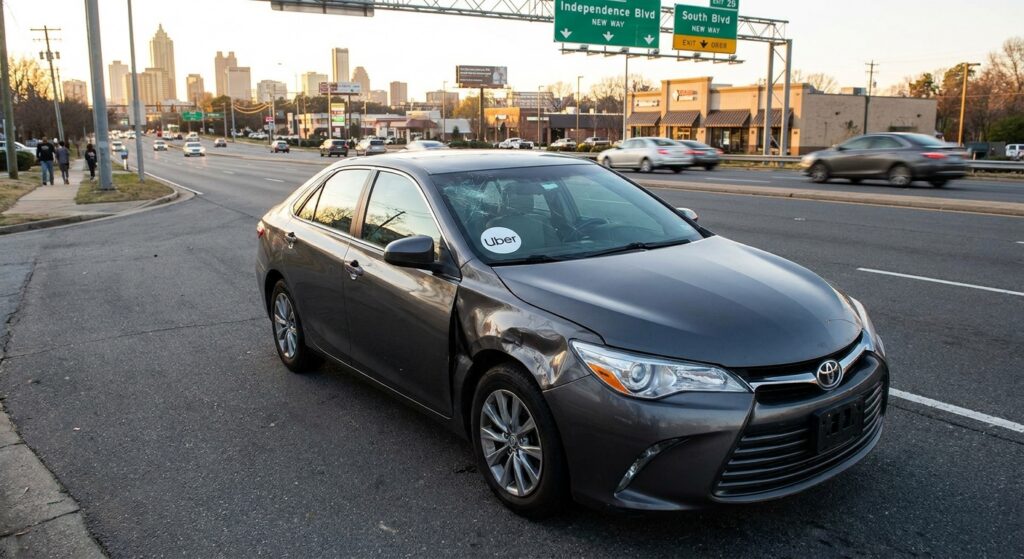
An Uber driver rear-ended you on South Boulevard, or T-boned you while you were turning left on Woodlawn Road, and now three insurance companies are each telling you the other two should pay. The driver’s personal carrier says he was logged into the app, so Uber’s policy applies. Uber’s claims team says the driver was off duty, so his personal policy applies. Your own carrier says you should collect from the at-fault party first. Meanwhile, medical bills keep arriving and no one is writing a check. This is where many uber accident claims in Charlotte stall in Carma Legal’s experience, and it is not because you filled out the wrong form or called the wrong number.
It may feel like the insurance companies are hoping you get tired and go away, and you are not imagining that. At Carma Legal, I have watched this play out many times over 12 years of injury work: each carrier denies the claim and blames another, and that pattern often continues until an attorney investigates what happened and works to determine which coverage applies. The pattern is predictable, which means it can be addressed.
This guide explains who may be responsible for payment after an Uber crash. It covers why the answer depends on what the driver’s app showed at the moment of impact, why North Carolina’s fault rule raises the stakes, how to avoid signing away your injury claim for a quick property check, and what Carma Legal does in the first 48 hours to address the finger-pointing.
Why Do Three Insurers Keep Denying Your Uber Accident Claims?
Insurers may deny the same Uber crash because none of them wants to be the one responsible for what happened, so each carrier names a different policy as the one that should pay. That standoff can continue until an attorney opens claims with every carrier involved, investigates which coverage applies, and works with each insurer regarding its role.
Picture a restaurant check sitting in the middle of a table with three people who each insist someone else ordered the expensive meal, so nobody reaches for it. Every day nobody pays is a day each insurer keeps its money. It is also a day closer to the point where you give up, or accept whatever offer finally shows up.
A rideshare crash invites this more than a typical wreck for a simple reason: there are more policies in play. A standard two-car crash usually involves the at-fault driver’s liability policy and your own. An Uber crash can involve the driver’s personal auto policy, Uber’s coverage, your own policy, and sometimes a third driver’s policy. Each of those can carry liability coverage, uninsured motorist coverage, underinsured motorist coverage, or medical payments coverage, and more than one can be used on the same crash.
You may be wondering whether a lawyer can change any of this, or whether you will just trade one runaround for another. Honest guidance matters more to me than a slogan. A lawyer cannot make an insurance company move faster by asking nicely. What may change the dynamic is investigation and structure.
When Carma Legal takes an Uber case, I start with every insurer listed on the police report and open a claim with each one, so no carrier can say it was never notified. From there, the work is investigating which coverage applies and sorting through the policies so that each insurer is answering for its own part. Once a carrier knows its piece of the claim has been identified, “that is someone else’s policy” may lose traction as an excuse.
Rideshare crashes are not rare edge cases anymore. Ride-hailing is common enough that researchers study its effect on road safety as a subject of its own, and the published studies do not all agree on its overall effect. What is not up for debate is the insurance complexity that follows when one of these crashes injures you.
How Does Uber’s Insurance Coverage Shift With App Status?
Uber’s coverage depends on what the driver’s app showed at the moment of impact. If the driver was logged off, the driver’s personal policy applies. If the driver was logged in with no passenger, Uber’s contingent liability layer may come into play. If the driver was on the way to a pickup or carrying a passenger, Uber’s $1 million commercial policy applies.
Think of the app as a light switch the driver flips with one tap on a phone. The crash happens in a single second, and whatever position that switch was in during that second decides whose money is on the line. That is why every carrier may have a reason to describe the switch differently.
| Driver’s app status at impact | Coverage first in line | What makes it hard to prove |
|---|---|---|
| Logged off | Driver’s personal auto policy | The personal carrier may claim the driver was working, to push the claim onto Uber |
| Logged in, waiting for a ride request | Uber’s contingent liability coverage | It generally applies only after the driver’s personal policy denies the claim |
| On the way to a pickup or carrying a passenger | Uber’s $1 million commercial policy | It requires timestamped trip records that Uber controls |
Proving which phase the driver was in at impact requires access to Uber’s trip data, and adjusters will not hand it over on their own. The driver’s word may not be sufficient, because the driver has an obvious stake in the answer. Your memory may not be enough either, because you had no way to see what the driver’s phone screen showed.
Many injured people do not realize that a subpoena cannot be served until a lawsuit is filed. Before litigation, nobody has the power to force Uber to produce its records. That does not put the record out of reach, but it does mean the record has to be protected early so it still exists when it can be compelled. This is where a preservation letter, sent when necessary in the first days after the crash, does its work.
North Carolina’s New Minimum Limits Still Leave Rideshare Passengers Underinsured
State minimum liability limits exist to put some floor on coverage, but the floor was built for fender benders, not serious injuries. When I review hospital bills and lost-wage statements from Carma Legal clients hit in rideshare crashes, the old minimums often covered less than half the actual loss, and the new minimums that took effect in July 2025 still leave gaps when injuries are substantial.
The minimums matter most when Uber’s commercial policy is not the one in play, or when someone other than the Uber driver caused the crash. If the at-fault driver carries only the state minimum, that per-person figure is the ceiling on what that policy pays you, no matter what your hospital bills look like.
Picture yourself in the back seat of an Uber on Independence Boulevard when another driver runs a light and hits your side of the car. If that driver carries only the minimum and you need surgery, months of physical therapy, and time off work, the at-fault policy may be used up before your losses are covered. Underinsured motorist coverage can pick up where that limit runs out, and uninsured motorist coverage can step in when the driver has no insurance at all or leaves the scene. Your own auto policy may carry both. Sometimes another policy on the vehicle, or covering the people driving it, carries them too.
Here is the honest picture from Carma Legal’s rideshare work: in most of these cases, coverage and limits are not the real issue. Usually the coverage exists. What matters most is getting your medical bills and treatment taken care of while your attorney handles the investigation and works out which limits apply. Serious-injury cases are where limits start to matter, because questions of permanency and causation (whether an injury is lasting, and whether the crash caused it) can affect your claim when losses extend past what a minimum policy was built to cover.
Your job in those first weeks is to keep up with your doctors and follow your treatment plan. Figuring out which policies apply, and in what order, is work you can hand off to an attorney.
Why Does Contributory Negligence Make the First 48 Hours Critical?
North Carolina is a contributory negligence state, so any shared fault can bar your claim entirely. That makes prompt investigation of app status and traffic-camera footage important before the other side builds a contributory negligence defense, which is an argument that you share part of the blame.
Most states let you recover something even when you were partly at fault, but North Carolina generally does not, apart from narrow exceptions such as the last clear chance doctrine. If an insurer can convince an adjuster, a mediator, or a jury that you contributed to the crash in any way, your claim can be barred. That one rule changes how fast evidence needs to be gathered.
Fault in a rideshare crash is not always as simple as who hit whom. An Uber driver who stops short in a travel lane on Queens Road to drop off a rider can change the fault picture in a rear-end crash that looks one-sided at first glance. So can a driver who cuts toward a pickup spot on Providence Road while glancing at a phone. The driver’s insurer, for its part, will look for anything that shifts blame onto you: your speed, your lane position, your turn signal, your phone.
Objective evidence may help address these arguments more than anyone’s memory. For intersection and left-turn crashes, including a T-bone collision, Carma Legal moves immediately to preserve 911 records, witnesses, satellite images, and surveillance and traffic-camera footage before any of it disappears. Much of that evidence will not wait. Camera systems can record over old footage, witnesses get harder to reach as weeks pass, and app-status logs sit in someone else’s hands. The footage that would have shown you had the green light can be gone before the first adjuster even calls you back.
How Does an Attorney Work to Force Insurers to Produce Policies and Address the Finger-Pointing?
With the evidence clock running, the next step is getting every insurer on record. Carma Legal opens claims with every policy listed on the police report, sends preservation letters when they are needed to protect app-status records, 911 recordings, and camera footage, and works with your own first-party insurer to identify other coverage that applies.
Here is what the first 48 hours look like when you hire Carma Legal after an Uber crash:
- A consultation to determine whether you may have a case.
- You sign the representation agreement.
- Carma Legal contacts the at-fault insurance company and works on addressing liability.
- We obtain the police report and property damage photos.
- We send preservation letters for app-status records, 911 recordings, and camera footage where necessary.
- We open claims with every insurance policy listed on the police report.
After that, the search for coverage widens. Your own insurer will often work with you to find other policies listed on the vehicle or covering the people driving it at certain times. Third-party companies can investigate and research additional applicable policies, and DMV tools can turn up coverage nobody mentioned. None of this requires a subpoena. It requires knowing where to look and being willing to keep working on it.
Then the coverage gets lined up in the right order. Your own medical payments coverage can help with early medical bills. The at-fault driver’s liability coverage is the main source for your injury claim, whether that coverage is a personal policy or Uber’s commercial policy. Underinsured motorist coverage comes into play when that liability limit is not enough, and uninsured motorist coverage applies when there is no liability coverage at all. Get the sequence wrong, and you can leave coverage unused or sign paperwork that closes one door before another opens.
Once an insurer accepts responsibility, the next challenge is often over the offer. One Carma Legal client came to me after receiving an offer that appeared low. Rather than just asking for more, I answered it with legal research and data: jury verdicts and settlements from similar cases in the same county. That contributed to an increased offer, but the client and I felt it still did not fairly reflect the claim, so we continued working and brought the insurer to mediation. There, we secured an offer that exceeded what the client expected. This describes the outcome in one documented case and does not represent a typical result. Comparable-case data turns an arbitrary discussion over numbers into a conversation about what the insurer might face in front of a jury.
That kind of work depends on an attorney who knows your file. I am licensed in two states, Nevada and North Carolina. I have practiced at big law firms in Las Vegas and boutique firms in North Carolina, and I have represented thousands of clients over 12 years. I keep Carma Legal small on purpose so I can stay engaged in the work, and you get direct access to an attorney by email, text, or call, not a hand-off to paralegals. Bar ethics rules prevent me from calling myself an “expert,” so I will not. I would rather show you the work.
What Happens If You Sign a Release Before Your Injuries Fully Surface?
Signing a release while you are still injured can give up your right to reopen the claim for medical expenses that show up days or weeks later. Rideshare adjusters know this, which is why they may push a fast property damage check and a recorded statement before you talk to a lawyer.
In the first days after a crash, your worries are practical. When can you get a rental car? When will someone pay for your totaled vehicle? Those are real needs, and an adjuster who solves them quickly can feel like a relief. The danger is in the paperwork that comes with the check. Some settlement documents bundle property damage and bodily injury into a single release, and once you sign a full release, the claim is closed, even if the stiffness in your back turns out to need months of treatment.
The recorded statement is the other concern. At Carma Legal, I regularly meet people who tried to handle the claim alone and, without realizing it, said something to the adjuster that complicated the claim or contributed to a denial. It might be a guess about your speed, an “I’m fine” said out of politeness, or a “maybe I didn’t see him.” In a contributory negligence state, one careless sentence can carry far more weight than it should.
If you have already talked to an adjuster or given a statement, do not assume your claim is finished. Tell your attorney exactly what was said and what you signed. A lot depends on the wording, and knowing where you stand is far better than guessing.
Until then, protect yourself:
- Get evaluated by a doctor and keep every appointment.
- Save your bills and records.
- Do not sign anything that says “release” or mentions bodily injury until a lawyer reviews it.
- Politely decline to give a recorded statement to the other side’s insurer until you have advice.
Carma Legal reaches out to the at-fault insurer within the first 48 hours, so those conversations come off your plate and you are not left negotiating with an adjuster while you are still hurt.
What Else Do Charlotte Riders Ask About Uber Accident Claims?
Most follow-up questions come down to coverage, timing, fault, and getting help. Uber’s coverage depends on app status, North Carolina gives you three years to file most injury claims, and any shared fault can bar recovery.
Does Uber’s insurance cover me if the driver was logged into the app but had no passenger?
Uber provides contingent liability coverage during that phase, but generally only after the driver’s personal policy denies the claim. Proving the driver was logged in requires trip data that the carrier will not release on its own, which is why preservation letters early in the case matter.
Can I settle the property damage now and file the injury claim later?
Not if you sign a full release. Many adjusters bundle property and injury into one settlement to close the file before your medical bills arrive, and that gives up your right to reopen the claim. Have an attorney read any settlement paperwork before you sign.
What if all three insurance companies keep denying my Uber accident claim?
That is common, and in my experience at Carma Legal insurers often keep denying until the injured person hires an attorney. Carma Legal opens claims with every policy on the police report, works with your own insurer, third-party investigators, and DMV tools to find any other applicable coverage, and then works to determine which policy applies. That process may end the excuse that the claim belongs to someone else.
How does North Carolina’s contributory negligence rule affect my rideshare claim?
If the other side proves you bear any share of fault, even a small one, your claim can be barred entirely. That makes it important to work on preserving traffic-camera footage, 911 recordings, satellite images, and witnesses right away, before the evidence is lost or overwritten.
Can I talk directly to the attorney handling my Uber crash?
Yes. Carma Legal is intentionally a smaller firm, so you reach the attorney directly by email, text, or call. The representation agreement you sign at the start lays out the terms in writing, so you know where you stand.
How long do I have to file an Uber accident claim in North Carolina?
North Carolina’s statute of limitations gives you three years from the date of injury for most personal injury claims. Evidence preservation should start much sooner, ideally within 48 hours, before cameras overwrite footage and app-status records become harder to secure.
If three insurers are pointing at each other right now, remember this: the record that may help settle most Uber coverage disputes is the driver’s app status at the exact second of impact. You do not have that record, and no one will hand it to you. The sooner a preservation letter goes out, the more likely that record still exists when it matters.
Call Carma Legal at 702-934-2228 for a consultation by phone, by video, or in person. You will get an honest answer about whether you may have a case. If you do, we will contact the at-fault insurer, open claims with every policy on the police report, work to preserve evidence before it disappears, and help determine your coverage before you sign anything. When you call, you speak with the Carma Legal attorney who will handle your case.
Talk Through Your Rideshare Accident Claim With Someone Who Understands the Coverage Rules
When an Uber crash leaves you injured, the question of which insurance applies can feel like a puzzle you shouldn’t have to solve on your own. Carma Legal works with people in Charlotte and Mesa who need clarity on what their claim is actually worth and who should be paying for it. A brief conversation can help you understand your options without any pressure to commit.
Individual client experiences vary, and outcomes in one case do not predict results in another.