
You were stopped, or nearly stopped. The light changed, you braked the way any careful driver would, and the car behind you did not. A few days later, the other driver’s adjuster calls. They are friendly and patient, and they ask questions that sound harmless: why did you stop so quickly, were your brake lights working, were you on your phone. You were the one who got hit, and now you are the one explaining yourself. If you are looking for a rear-end collision lawyer in Charlotte like Carma Legal, that phone call is usually the reason, more than the crash itself.
Before I represented injured people at Carma Legal, I worked on the other side, defending insurance companies. I know what those questions are for. They are not small talk, and they are not the adjuster trying to understand your side. In North Carolina, they can be the first step toward a denial that takes away your entire claim, which is why the conversation you have this week matters more than most people realize.
This guide covers four things. It explains how fault works in a rear-end crash and why North Carolina’s contributory negligence rule makes a “shared responsibility” comment so dangerous. It walks through the evidence that proves the driver behind you caused the collision. It explains how I evaluate whether an offer holds up. And it shows how Carma Legal handles these cases for people in the areas we serve, Charlotte and Mesa.
If the Law Puts the Duty on the Driver Behind You, Why Is the Adjuster Blaming You?
The adjuster is blaming you because, in North Carolina, shifting even a small piece of fault onto you can wipe out the insurer’s entire payout. The law puts the duty to keep a safe distance on the driver behind you, so the adjuster’s strategy is to find a reason you share the blame.
North Carolina’s following-too-closely statute, N.C. Gen. Stat. § 20-152, says a driver shall not follow another vehicle more closely than is “reasonable and prudent.” That means leaving enough space to account for speed, traffic, and road conditions. Think of it like the space you leave behind someone on a staircase. If they stop and you run into them, nobody asks why they stopped; the question is why you were close enough to hit them. In many rear-end accidents, the impact itself is strong evidence that the trailing driver was following too closely, was not paying attention, or both.
Insurers know this, so in rear-end collisions they rarely argue the basic facts. Instead, they tell one of three stories: you stopped short for no reason, you changed lanes suddenly and cut them off, or your brake lights were not working. That last one is not random. North Carolina’s signaling statute, N.C. Gen. Stat. § 20-154, requires drivers to make sure a stop can be made safely and to signal it when other drivers may be affected. For most of us, brake lights are that signal, so if an adjuster can suggest yours were out, they have a hook.
Having defended insurers, I have seen these arguments assembled from the inside. Picture stop-and-go rush-hour traffic on one of Charlotte’s busy commuter roads. A driver who tailgates in that traffic is not surprised by a stop, because stops are the whole pattern of driving there. Braking for a yellow light is what the law expects of a careful driver, and it is not an excuse for the person behind you.
How North Carolina’s Contributory Negligence Rule Turns a Casual Fault Suggestion Into a Total Loss Strategy
Under North Carolina’s contributory negligence rule, if you are found even slightly at fault for causing the crash, you can be barred from recovering anything. So when an adjuster says you “might share some responsibility,” they are not negotiating. They are building a case to pay you nothing.
Here is a plain way to picture it: most states grade fault on a curve, and North Carolina grades it pass or fail. In many states, a driver who is partly at fault still recovers, just less. In North Carolina, a jury finding that you were even one percent negligent, and that your negligence contributed to the crash, can end your claim completely. Your medical expenses, your lost wages, your pain and suffering, and your damaged car all go with it. That is why every conversation with the other driver’s insurer is zero-sum, and anything that moves the fault needle toward you is a win for them.
There is one important protection. Under N.C. Gen. Stat. § 1-139, the defense must raise contributory negligence and prove it at trial. The burden is on them, not you. An adjuster’s suggestion is not a finding; it is a theory, and theories can be taken apart with evidence. North Carolina courts also recognize narrow exceptions, such as the last clear chance doctrine. Whether one applies depends on the specific facts of your crash, which is one more reason those facts need to be locked down early.
Arizona works very differently, and the contrast shows how high the stakes are in Charlotte. Arizona follows pure comparative fault under A.R.S. § 12-2505, which means your recovery is reduced by your share of fault but not erased. Arizona also has its own following-too-closely law, A.R.S. § 28-730. For someone rear-ended on a Mesa freeway, a fault argument affects how much you recover. For someone rear-ended in Charlotte, it can decide whether you recover at all.
What Evidence Does a Rear End Collision Lawyer Gather to Prove the Trailing Driver Was at Fault?
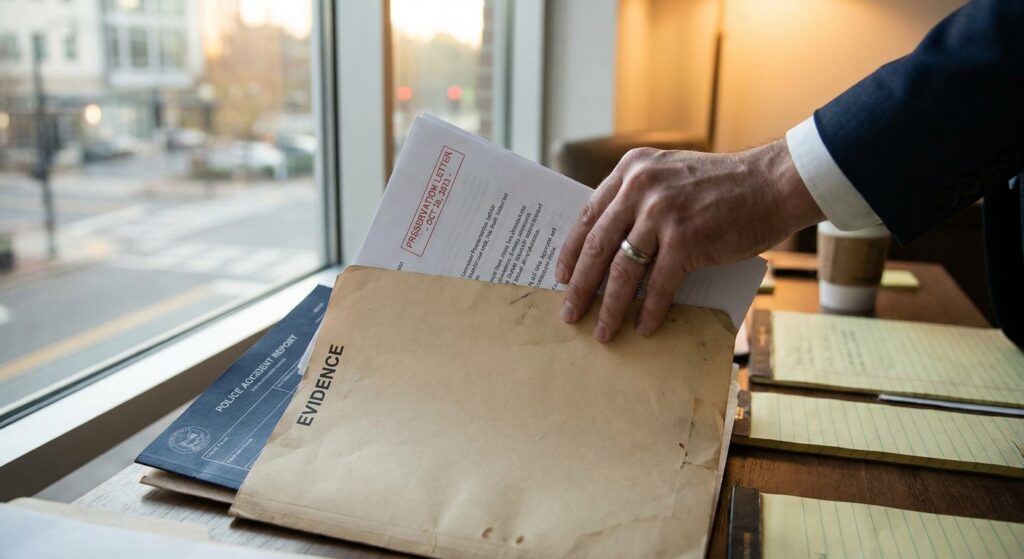
A rear-end collision lawyer proves fault by securing evidence quickly, ideally within the first 48 hours: the police report, photos of the vehicles and your injuries, witness statements, and, if distraction is suspected, the other driver’s phone records. This evidence is what stops an insurer from rewriting the crash weeks later.
Here is what I work to preserve at Carma Legal, and why each piece matters:
- The police crash report. In North Carolina, this is the DMV-349. It records vehicle positions, the officer’s observations, any citations, and witness contact information.
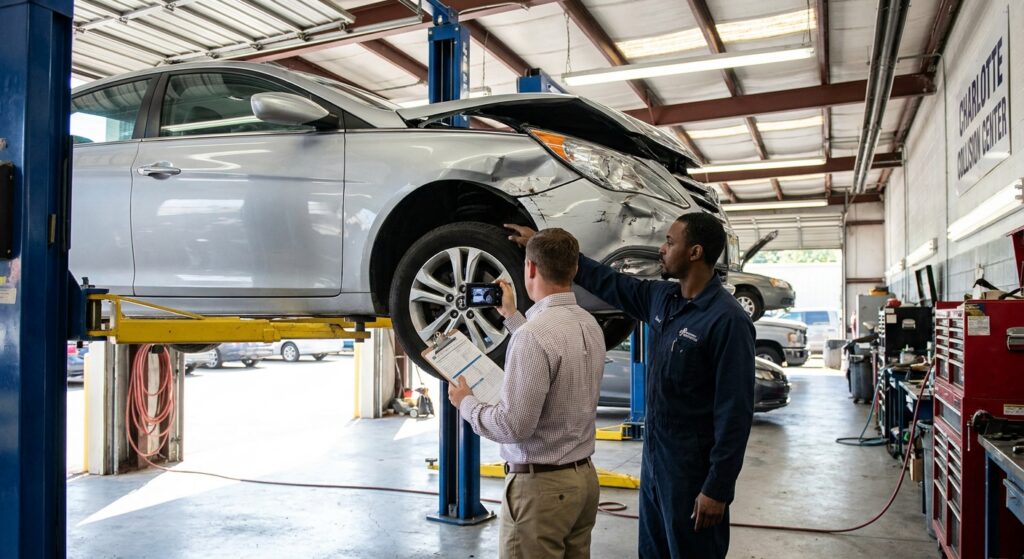
- Photos of the damaged vehicles. Damage to your rear bumper and the other car’s front end tells a clear story about who hit whom and how hard. Take them from several angles, including where the cars came to rest if you still can.
- Skid marks and road conditions. Marks, or the lack of them, can show whether the other driver braked at all.
- Photos of your taillights and brake lights. If the adjuster claims your lights were out, a photo of them working after the crash, along with repair records, answers that directly.
- Photos of your injuries. Bruising from a seat belt or airbag fades within days, but a photo taken in the first 48 hours does not.
- Witness statements. People move, change numbers, and forget details, so a statement taken this week is worth far more than one attempted in three months.
- Cell phone records. If there is reason to believe the other driver was distracted, I send a preservation demand early. If the case moves into a lawsuit, those records can be requested through discovery.
- Video and vehicle data. Dash cams, nearby business cameras, and a vehicle’s onboard data can show speed and braking. Many camera systems record over old footage, so timing matters.
The reason for speed is simple. Weeks after the accident, the adjuster may say you stopped short or that your lights were out. If the only record is your memory against the other driver’s, that becomes a credibility contest, and in North Carolina a contest over fault is exactly where contributory negligence does its damage. A photo, a witness, or a phone record turns that contest back into a fact.
The other key piece of evidence is your own medical record. If you are hurt, get seen now. Every week you wait gives the insurer room to argue your injuries came from something else or are not serious, and that is one of the most common ways they devalue a claim. From the first call, I prepare these cases at Carma Legal from the beginning as if they are headed to trial, because that preparation is what gives your claim weight when the insurer tests it.
The Adjuster’s Friendly Questions Are Building a Fault Story Against You
Evidence is only half the fight. The other half is what you say and sign. The two mistakes I see most often, before people ever reach an attorney, are talking to the insurance company yourself and signing paperwork. Do neither in those first 48 hours.
A recorded statement feels routine, but it is made to be used later. If you say, “I guess I stopped kind of suddenly,” that sentence can end up in a denial letter as an admission. If you say, “I’m okay,” before a neck or back injury has fully shown itself, the adjuster may quote it back to you months later as proof you were not hurt. Neither comment means you were at fault or uninjured, but in a contributory negligence state the insurer does not need a confession. It only needs a sentence it can use.
Delay is the other tool. At the start, most people are focused on practical problems: when they can get a rental, when the body shop will call, and how the property damage side will be handled. An insurer that is slow to move knows you need transportation. That pressure is when a lowball offer tends to show up, sometimes with a release attached that settles more than the car. Signing it can close your injury claim before you know what your injuries will cost.
Here is the difference when I step in at Carma Legal. The adjuster stops calling you and starts calling me. I walk you through the property damage process and handle communication with the insurers, so you are not managing them while you recover. What I refuse to do is let an adjuster set the fault narrative by default because nobody pushed back. Reporting the crash to your own auto insurer under your policy is a separate conversation, and I can walk you through that too.
Is the Offer Fair? How I Measure It Against a Charlotte Jury
Once fault is protected, the next question is usually about the offer itself. I measure an offer against one standard: what a jury in the county where your case would be tried might award, though every case is different and outcomes depend on the specific facts, injuries, and evidence presented. That depends on your injuries, how the crash affected your life, your ability to work, and how severe the collision was, along with how strong the evidence of the other driver’s fault is.
An adjuster’s valuation reflects what the insurer hopes you will accept. I spent time on that side of the table, so I know how those numbers get built and where they tend to leave things out. My evaluation at Carma Legal starts from the other direction: what people from your community would likely decide after hearing the full story of your crash and your recovery.
Local context matters here. A Charlotte juror has sat in rush-hour traffic and knows what it takes to follow someone safely through it. I want to be able to tell my client’s story because I actually know their story, and that only happens when the attorney is the one talking to you from the start.
I also want to be clear about what I will not do. I cannot predict a specific outcome or value in your case, and no attorney can guarantee any particular result. Every case is unique and outcomes vary widely based on individual circumstances, the severity of injuries, the strength of evidence, and many other factors. I would rather be candid with you than tell you what you want to hear. What I can offer is honest guidance: I will tell you how I see an offer against those factors and give you my recommendation. The decision to accept or to move into litigation is always yours. Because I work on contingency, you pay no attorney’s fee up front, and my interests are aligned with yours.
Why Does Direct Access to Your Attorney Matter the Day an Adjuster Calls With a Fault Allegation?
Direct access matters because a fault allegation needs an answer the same day, not next week. At Carma Legal, you can text, email, or call me directly and get guidance before the adjuster’s version of events settles in.
Picture the other setup. The adjuster calls on a Tuesday and says you stopped short. You call your law firm and leave a message for a case manager, who passes it to a paralegal, who adds it to the attorney’s list. By the time an answer reaches you, the insurer may already have noted your silence, or a confused reply, as agreement with its version. In a state where a small share of fault can end a claim, that gap is not just an inconvenience. It is a risk.
I run a smaller firm on purpose at Carma Legal so I can be boots on the ground throughout every case. After working in big law firms, I chose a different model: I handle each client with care, and I am intentional about the cases I take. When you call to find out whether you have a case, you talk to me, not staff. You see my face on the website and hear my voice on the phone. I analyze your situation, investigate it, and walk you through it. Most people call with the same urgent questions: how the property damage process works, what the case will look like, what the attorney’s fees are, and how long it takes. I answer every one in detail. Then I tell you to feel free to call me back the next day, because a crash is traumatic and new, and more questions come once the shock wears off.
That access comes with experience. Over 12 years I have represented clients in a range of cases, from minor impacts to serious collisions that required surgeries and extended recovery, though each person’s experience and outcome is different. I am licensed in two states, North Carolina and Nevada, and I have practiced in both large firms and boutique firms. My time defending insurance companies taught me how they build fault arguments. I also owe every client the duties of loyalty and zealous advocacy under the North Carolina State Bar’s Rules of Professional Conduct. Direct access to an attorney, clear communication, honest guidance, and a case prepared from the beginning are not extras; they are how I practice at Carma Legal.
Questions Charlotte Drivers Ask When an Insurer Blames Them for a Rear-End Crash
Can an insurance company blame me for a rear-end collision if I stopped suddenly at a yellow light?
They can try, and adjusters often do. North Carolina law requires the following driver to keep a safe distance, and stopping for a yellow light is what a careful driver does. The key question is whether the driver behind you left enough room to react, and evidence such as photos, witness accounts, and vehicle damage usually answers that.
What does contributory negligence mean for my rear-end collision claim in North Carolina?
It means that if you are found even slightly at fault for causing the crash, you can be barred from recovering any compensation. That is why an adjuster’s suggestion that you share responsibility is a strategy to eliminate your claim, not a compromise. The defense carries the burden of proving it.
What evidence do I need to prove the other driver was at fault in a rear-end collision?
The most useful evidence is the police crash report, photos of the damaged vehicles, skid marks, photos of your working brake lights and your injuries, witness statements, and, if distraction is suspected, the other driver’s phone records. Much of this is easiest to secure within the first 48 hours.
Should I give a recorded statement to the at-fault driver’s insurance company after a rear-end collision?
No. Do not speak with the at-fault party’s insurance company yourself, and do not sign any documents in the first 48 hours. Early statements are used to build fault arguments before you know the full extent of your injuries. Let your attorney handle that communication.
How does a rear-end collision lawyer evaluate whether a settlement offer is fair?
At Carma Legal I compare the offer to what a jury in the county where the case would be tried might award, weighing your injuries, the impact on your life and ability to work, and the severity of the crash, though every case is different and no attorney can predict what a jury will decide in any specific case. I give you my advice, but the final decision to settle or file suit is always yours.
How long do I have to file a rear-end collision lawsuit in North Carolina?
North Carolina generally allows three years from the date of the crash for a personal injury lawsuit under N.C. Gen. Stat. § 1-52. Arizona generally allows two years under A.R.S. § 12-542. Evidence disappears much faster than either deadline, so an early consultation protects your ability to prove fault.
Before You Return the Adjuster’s Call, Talk to the Attorney Who Will Handle Your Case
If an adjuster has already hinted that your brake lights were out or that you stopped too fast, do one thing today. Photograph your taillights working, before the car goes to the body shop and that evidence is repaired away. Then write down exactly what the adjuster asked you and when. Those two steps take ten minutes, and in a contributory negligence state they can protect your entire claim.
Call Carma Legal today at 702-934-2228. I will review the adjuster’s fault claim with you, help preserve the evidence that proves the trailing driver’s liability, and protect your claim before a contributory negligence argument can take hold. You will speak with me, the attorney who will actually handle your case, by phone or video, and because I work on contingency there is no attorney’s fee up front. The adjuster’s questions were written before you ever picked up the phone, and your answers deserve the same preparation.
Talk to an Attorney Who Knows How Insurers Shift Blame
When an insurance company questions who caused your rear-end collision, the right evidence makes all the difference. Carma Legal has helped clients in Charlotte and Mesa push back against fault claims that don’t match the facts. If you’re facing a denial or lowball offer because the insurer says you share responsibility, a conversation with our team can clarify your options and what comes next.
Every case is different. Outcomes depend on the unique facts, injuries, evidence, and many other factors in each individual situation. No attorney can guarantee any particular result.