
This week you are making calls no family should have to make. You are calling relatives who live hours away, a funeral home, an employer, and a bank that will not talk to you without a death certificate. In the middle of all that, an adjuster for the other driver’s insurance company has already asked for a few minutes of your time. A relative may have told you to “just let the insurance handle it.” You are now making decisions for someone who cannot make them, and you are afraid of getting it wrong. This guide explains what North Carolina law requires after a fatal crash, what disappears if you wait, and what to look for in a car accident attorney in Charlotte, NC, for a wrongful death claim. The goal is simple: the choices you make in the next few weeks should be informed ones.
You may feel that calling a lawyer this soon is cold, or even disrespectful to the person you lost. That feeling is common, and it makes sense. A phone call does not commit you to anything. What it can do is protect evidence, slow down an insurer that is already moving, and give your family a clear picture of the decisions ahead.
Over roughly 12 years, I have represented thousands of clients, first at big law firms in Las Vegas and later at boutique firms in North Carolina. Before I represented injured people and families, I spent time defending insurance companies. That background shapes everything below. I have sat on the side of the table that evaluates fatal claims, and I know what an insurer’s file looks like in the first few weeks after a death.
Why the First 48 Hours After a Fatal Charlotte Crash Decide What Evidence Your Family Can Still Recover
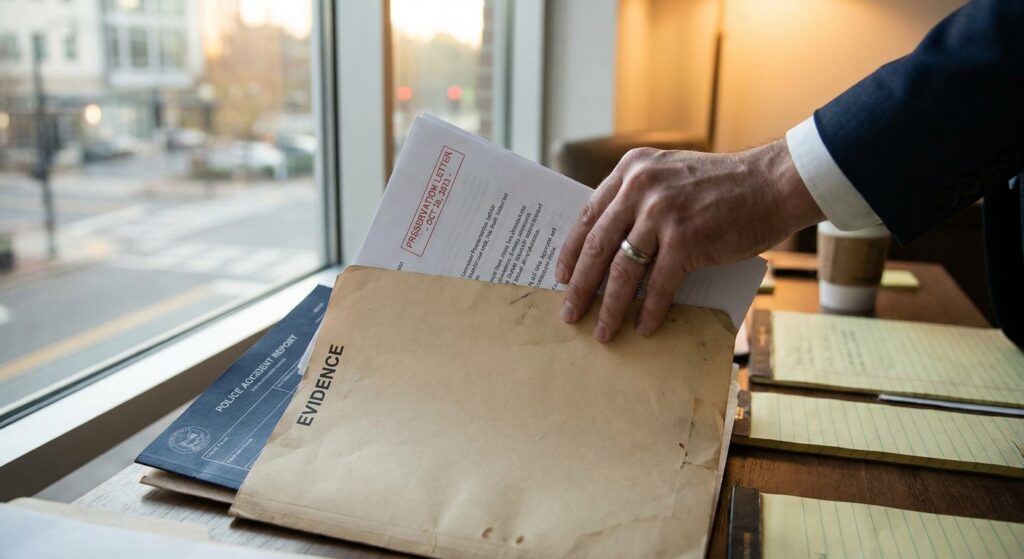
Much of the evidence that shows how a fatal crash happened can be lost within days, including surveillance video, vehicle computer data, and marks at the scene. Preservation letters sent in the first 48 hours put the people holding that evidence on written notice to keep it.
Start with what was at the scene. Skid marks, gouges in the pavement, and debris fields tell an accident reconstruction specialist where the vehicles were and how fast they were moving. On a road like I-485 or Independence Boulevard, crews clear the scene quickly so traffic can move again, and rain and later traffic wear away whatever is left. Photos taken that day, by police, witnesses, or anyone in your family, may be the only record.
Video is even more fragile. Gas stations, stores, apartment complexes, and office buildings often record over their footage on a short loop, sometimes about a week. Once it is overwritten, it is gone for good.
The vehicles hold evidence too. Most modern cars have an event data recorder, often called a black box. It captures speed, braking, throttle, and seat belt use in the seconds before impact. When a car is totaled, the insurer often moves it to a salvage yard, where it can be sold or crushed. If no one downloads that data first, it may disappear with the car. Commercial trucks and delivery vans may also carry telematics and driver logs, and the companies that own them do not keep that data forever.
A preservation letter is a formal written demand to keep specific evidence. It goes to the at-fault driver’s insurer, to any fleet operator or employer involved, to nearby businesses with cameras, and to the city departments that manage traffic signals. Once that letter is on file, it is much harder for anyone to claim later that they did not know the evidence mattered. This is what being prepared from the beginning looks like in practice: the investigation starts while the evidence still exists, not months later when someone finally asks for it.
For your family, an important step right now is to protect the vehicle. Do not sign the car over to any insurer or salvage company until someone has documented it and pulled its data. Save every photo and text message from the day of the crash, and write down the names of anyone who stopped to help. None of this has to wait for the estate paperwork described in the next section.
Who Can Actually File a Wrongful Death Claim in North Carolina, and Why Does That Matter Right Now?
In North Carolina, only the personal representative of your loved one’s estate can bring a wrongful death claim, under N.C. Gen. Stat. § 28A-18-2. A spouse, parent, or adult child cannot file in their own name, which means the estate has to be opened in probate before a claim can move forward.
This catches many families off guard, because they assume any next of kin can call the insurer and make a claim. The personal representative is the executor named in a will or, if there is no will, an administrator appointed by the court. In Charlotte, the estate is opened through the Clerk of Superior Court in Mecklenburg County. The North Carolina Judicial Branch explains the general process: you file an application, provide the death certificate and any original will, identify the heirs, and in some cases post a bond. Depending on the paperwork, whether there is a will, and whether the family agrees on who should serve, it can take days or weeks.
One detail in the statute often settles family tension. Wrongful death money does not pass through the will the way other property does. The same statute directs that the recovery be distributed under North Carolina’s Intestate Succession Act, and with limited exceptions for certain funeral and medical expenses, it is generally protected from the estate’s debts. Choosing someone to serve as personal representative does not mean that person keeps the money. It means that person has the legal authority to act for everyone the law protects.
The timing problem is real. Evidence needs attention this week, but the estate may not be open for some time, so the work should run on two tracks at once. While you work with the clerk’s office, preservation letters and the early investigation can begin. Before any claim is filed, I walk families through probate step by step: who should serve, what the clerk will ask for, and what to expect if the person you choose lives outside North Carolina. You should not have to work out probate rules alone while you are planning a funeral.
What Insurance Adjusters Do in Hospital Waiting Rooms, and What to Say When They Contact You
Adjusters often reach out within hours or days of a fatal crash, sometimes in person. Their job is to protect the insurance company, not your family. You can politely decline to give a recorded statement, and decline to sign anything, until you have spoken with an attorney.
The approach is usually gentle. An adjuster may say they want to “help the family during this difficult time,” that they need a statement “while memories are fresh,” or that they can move quickly on funeral costs. Some ask you to sign a medical authorization so they can “process things faster.” None of this sounds threatening, and that is the point. A grieving parent in a hospital hallway is not thinking about how a recorded conversation might sound to a defense lawyer a year from now.
I know this playbook because I used to work on the insurer’s side of it. On defense, early statements were reviewed line by line for anything that could shift blame onto the person who died. In North Carolina, that matters a great deal, because even a small share of fault can bar the claim (explained below). An offhand comment like “he was probably tired after his shift” or “she always drove a little fast” can become the centerpiece of a denial. Broad medical authorizations let the insurer search years of records for something to blame, and a quick check for funeral expenses can come with release language that reaches far beyond the funeral.
Here is what you can say, word for word: “Thank you. Our family is not ready to discuss the crash. Please send anything you need in writing, and our attorney will contact you.” Write down the adjuster’s name, company, phone number, and claim number. Do not guess about speed, fault, or what your loved one was doing before the crash. Do not sign releases, authorizations, or vehicle title transfers, and do not cash any check marked “full and final.” Keep in mind, too, that until a personal representative is appointed, no one in your family has authority to settle the wrongful death claim. You lose nothing by waiting a few days to get advice.
What Damages Does North Carolina Law Allow, and Why Do Early Offers Rarely Reflect Them?
North Carolina’s wrongful death statute allows recovery well beyond funeral bills. It covers medical expenses, your loved one’s pain and suffering before death, lost income, and the value of their care, companionship, and guidance to the family. Early offers usually arrive before anyone has measured those losses.
Families are sometimes told that North Carolina only pays “funeral bills and maybe lost wages.” That is not what the law says. Under § 28A-18-2(b), damages can include:
- Medical, hospital, and care expenses related to the injuries that caused death
- Compensation for the pain and suffering your loved one experienced before death
- Reasonable funeral expenses
- The present monetary value of your loved one to the family, including net income they would have earned, services, protection, care, assistance, society, companionship, comfort, guidance, and advice
- Punitive damages in limited circumstances, such as some drunk driving cases, under North Carolina’s punitive damages law
The fourth category is where early offers fall furthest short, because it takes real work to document. You have to look at your loved one’s work history, benefits, and the years they likely had left in their career. You also have to count the household services that never show up on a pay stub: picking up the kids, repairing the house, driving a parent to appointments, managing the family finances. Then there is the value of their presence. A jury can consider that, and an adjuster’s first offer almost never does.
That gap is why a fast number does not earn a fast yes from me. In one crash claim, a client I worked with received a lowball offer, and I declined to settle at that figure. Simply asking for more money rarely moves an adjuster, so I answered with legal research and data: jury verdicts and settlements from similar cases in the same county, laid out to show the insurer why the claim deserved consideration for more. The offer rose, but I still did not believe it fairly compensated my client, so we kept pressing, brought the insurer to mediation, and eventually secured an increased offer. Individual results vary, and past results do not guarantee future outcomes. Sometimes meaningful negotiation means filing suit and putting the case in front of a jury. In a wrongful death case, that decision belongs to the personal representative, with my advice.
How Long Do You Have to File in North Carolina, and Why Can Waiting Six Months Hurt Your Case?
Under N.C. Gen. Stat. § 1-53(4), a wrongful death lawsuit generally must be filed within two years of the date of death. That sounds like plenty of time, but in practice the work needed to prove fault often takes longer than families expect.
Picture a common timeline. The first several months go to the funeral, the estate, and simply getting through each day. The family then spends a few more months talking informally with the adjuster, assuming things will work out. Then the insurer denies liability, claiming your loved one drifted over the center line on Providence Road or changed lanes without looking on I-85. Suddenly the case needs accident reconstruction, records from the trucking company or the city, depositions of the other driver and witnesses, and a full economic analysis, and all of it has to fit into whatever time is left.
Delay causes damage in quieter ways too. Witnesses move, change phone numbers, and forget details. A person who was sure the light was red may only remember “a loud bang” a year later. Meanwhile, the insurer has been building its file around its own driver’s account since the first day. By the time your family is ready to push back, that story has been repeated so often that it reads as settled fact.
Some deadlines are also shorter than two years. Claims involving a government entity can carry their own notice requirements and procedures, and insurance policies, including underinsured motorist coverage, often require prompt notice of a claim. I would rather be candid with you about this now than have you discover a missed deadline in month twenty. The clock does not stop while your family grieves, but your attorney can carry the deadlines so you do not have to.
Coverage Sources Families Overlook: UIM Policies, Employer Liability, and Government Claims
The at-fault driver’s liability policy is often only the first place to look. Underinsured motorist coverage on your loved one’s own policy, other policies in the household, an employer’s coverage if the other driver was working, and sometimes a claim against a government entity may also apply.
Many families assume the other driver’s policy limit is the end of the story. North Carolina sets minimum liability limits under N.C. Gen. Stat. § 20-279.21, and those minimums are small compared with a lifetime of lost income, care, and support. When the at-fault driver carried only minimum coverage, the family’s own policies matter enormously. Underinsured motorist (UIM) coverage on your loved one’s policy, and sometimes on other policies in the same household, can add coverage depending on the limits purchased. The details sit in the declarations pages and endorsements, which most people have never read closely.
Next, look at who the other driver was working for. If they were on the clock, driving a delivery van, a contractor’s truck on I-77, or a company car, the employer may be responsible for the crash. The company may also be directly liable for negligent hiring, poor training, or failing to maintain the vehicle. Rideshare platforms carry their own policies, which can apply depending on what the driver was doing at the time. And if your loved one was driving for work, workers’ compensation death benefits may be part of the picture alongside a claim against the at-fault driver.
Sometimes the road itself played a role, through a malfunctioning signal, a missing guardrail, or a dangerous design. Claims against government entities follow their own rules on immunity, notice, and even which forum hears the case. Having handled claims for insurers, I know families are rarely told about these other sources, and I have seen a single policy limit presented as though it closes the conversation. That is why I track down every possible source of coverage before anyone talks about numbers.
How Does North Carolina’s Contributory Negligence Rule Affect a Wrongful Death Claim?
North Carolina still follows contributory negligence. If your loved one is found even slightly at fault for the crash, the wrongful death claim can be barred completely. Insurers know this, and many build their entire defense around it.
A wrongful death claim in North Carolina depends on whether your loved one could have sued if they had survived, so any fault the insurer can pin on them carries straight into the family’s case. Contributory negligence is a defense the insurer must raise and prove, a burden placed on the defendant under N.C. Gen. Stat. § 1-139. The problem is that insurers do not need to prove much. A sliver of fault can be enough to end the claim in some cases.
The tactics tend to follow the roads. On I-77 and I-85, insurers often argue speed or an unsafe lane change during heavy merging. At intersections along South Boulevard and Providence Road, they point to signal timing, a left turn, or a claim that your loved one “should have seen” the other vehicle. They may suggest phone use, fatigue, or impairment, sometimes with no real evidence behind it. Some try to raise seat belt use, even though North Carolina law generally keeps evidence that someone was not wearing a seat belt from being used to show contributory negligence, under N.C. Gen. Stat. § 20-135.2A.
There are answers to these arguments, but they depend on evidence. Black box data can show your loved one was driving at the speed limit and braking. Signal timing records can show who had the green light. Witness statements taken early can lock in the sequence of events before memories blur. In some cases, doctrines such as last clear chance, or the other driver’s gross or willful conduct, may prevent contributory negligence from barring recovery. This is why the evidence work in the first section matters so much: the data that answers “he was speeding” is the same data that disappears when a totaled car is sold. For a deeper look at the rule itself, our blog covers North Carolina contributory negligence in more detail.
What If Your Loved One Lived or Worked Across State Lines?
When a crash happens in North Carolina but your loved one lived, worked, or was insured in another state, more than one state’s law may come into play. Which wrongful death rules, deadlines, and fault standards apply depends on where the crash happened, where everyone lives, and where a case can be filed.
This comes up often around Charlotte. Many families live just across the state line and commute into the city every day. Others have a loved one who moved away for work, or relatives in other states who are suddenly part of the decision. As a general starting point, the law of the place where the crash happened often governs questions of fault. But an insurance policy written in another state may have its own terms for UIM coverage, and the person best suited to serve as personal representative may live hundreds of miles away.
These details change the strategy. States differ on who may bring a death claim, how fault affects recovery, what damages are allowed, and how long the family has to file. A family that assumes one state’s deadline applies may miss a different one. Relatives from out of state often bring advice that is accurate where they live but wrong under North Carolina law, which can create conflict at the very moment the family most needs to agree.
Carma Legal has offices in Charlotte and in Mesa, Arizona, and I am licensed to practice in both North Carolina and Nevada, having worked at large Las Vegas firms before moving to boutique practice in North Carolina. For families whose lives stretch across state lines, that means the jurisdiction question can come up in the very first conversation instead of being discovered late. I can help you spot early which rules are likely to matter and what they mean for timing, so a deadline in one place does not slip past while the family is focused on another. Phone and video consultations make this practical for relatives who cannot travel to Charlotte.
What Should Families Look for in a Car Accident Attorney in Charlotte, NC for Wrongful Death?
Look for an attorney who will personally handle your family’s case, who prepares it for trial from the beginning, and who understands how insurers evaluate fatal claims from the inside. Ask directly who you will talk to when you call, and how often you will hear from them.
The firms behind the biggest billboards often run on volume. Cases are passed to case managers, families leave messages that sit for days, and clients become file numbers. In a wrongful death case, that model can fail families when they most need answers: in the weeks when you are deciding whether to speak with an adjuster, sign a form, or let the car go to salvage. Carma Legal works differently. You get direct access to an attorney, not paralegals or intermediaries. The face on the website is mine, and when you call, the voice you hear is mine too. I manage every part of the case personally, the lines of communication stay open, and your family’s questions get answered as the case moves forward.
Experience matters too, and you should ask about it plainly. I hold law licenses in North Carolina and Nevada. I have practiced at big firms in Las Vegas and at boutique firms in North Carolina, and I have represented thousands of clients over approximately 12 years. Before that, I worked for insurance companies, defending claims on their behalf. Bar ethics rules do not allow me to call myself an expert, but I can tell you this: there is no trick or tactic an insurer uses on a fatal claim that I have not already seen from their side of the table.
Then there is preparation. Every case I take is organized from day one as though it will go in front of a jury. That means looking at venue and the likely jury pool in Mecklenburg County, gathering verdicts and settlements from similar cases in the same county, building the evidence of causation, and documenting the full scope of the family’s losses. Many cases resolve through negotiation or mediation, and insurers tend to take a case more seriously when they can see it is ready for trial. In a wrongful death case, preparation also means knowing the person you lost. I want to be able to tell a client’s story because I actually know their story. When the client is a family, that story is your loved one: who they were, what they did for the people around them, and what is missing now.
What Happens During a Free Consultation About a Wrongful Death Case?
A free consultation with Carma Legal is a conversation with the attorney who would handle your family’s case, not an intake script. Wrongful death cases are handled on a contingency fee, which means there is no attorney fee unless there is a recovery.
The first part of the conversation is listening. I want to hear what happened, what the family has been told so far, and who your loved one was. From there, we work through the urgent questions. Has anyone contacted an insurer? Where is the vehicle? Has the estate been opened, and who is the right person to serve as personal representative? I will explain the probate steps the Mecklenburg County clerk will expect before a claim can be filed, and what can start right away, such as preservation letters, while that paperwork is underway.
It helps to bring whatever you have, but do not delay the call if some of it is missing:
- The death certificate, or the funeral home’s contact information if it has not been issued yet
- The crash report, or the report number from the investigating agency
- Insurance declarations pages for every vehicle in your loved one’s household
- Any business cards, letters, emails, or checks from insurance companies
- Medical bills, funeral bills, and any hospital paperwork
- Pay stubs, tax returns, or benefits information for your loved one
- A will, if one exists, and any letters the clerk has already issued
- Photos, videos, and names of witnesses
You should also feel free to question me. Ask who will handle the case day to day, how quickly you will get a call back, how I prepare a case, and how I will keep the family informed. My answer to the first question is simple: me. I would rather give you honest guidance than tell you what you want to hear. If I do not think your case is a fit, I will tell you, and I will not put a dollar figure on your family’s claim in a first meeting. The contingency fee agreement spells out in writing how fees and case costs work before you sign anything. If you cannot come to the Charlotte office, we can meet by phone or video.
What Do Families Ask Most After a Fatal Charlotte Crash?
These are the questions families raise most often in the first weeks. Each answer reflects North Carolina law, and your family’s situation may add details worth discussing directly.
Can I file a wrongful death claim in North Carolina if I am the spouse or parent of the person who died?
Not in your own name. Under § 28A-18-2, only the personal representative of the estate can bring the claim, and the estate must be opened in probate first. You may be the person appointed, and any recovery goes to the heirs under North Carolina’s intestate succession rules.
Should I talk to the at-fault driver’s insurance adjuster if they contact me in the hospital or at home?
Be polite, but decline to give a recorded statement or discuss the crash until you have spoken with an attorney. Early statements can be used to argue that your loved one shared fault, and under North Carolina’s contributory negligence rule, that can end the claim. Take the adjuster’s contact information and ask them to put requests in writing.
What damages can a wrongful death claim recover in North Carolina?
The statute allows recovery for medical expenses, your loved one’s pain and suffering before death, and funeral costs. It also covers the present value of their income, services, care, companionship, and guidance to the family. Punitive damages may be available in limited cases. What applies depends on the facts, and results vary.
How long do you have to file a wrongful death lawsuit in Charlotte?
Generally two years from the date of death, under § 1-53(4). Some related deadlines, such as notice to a government entity or an insurer, can be shorter. Waiting also costs evidence and witness memory long before the legal deadline arrives.
What if the at-fault driver only has minimum insurance and my loved one was the primary earner?
Look beyond that policy. Underinsured motorist coverage on your loved one’s own policy, other household policies, the at-fault driver’s employer, or a government entity tied to the road may provide additional coverage. The answers are usually in policy documents most families have never reviewed.
Does it cost anything to talk to a Charlotte car accident attorney about a wrongful death case?
No. Carma Legal offers a free consultation, and wrongful death cases are handled on contingency, so there is no attorney fee unless there is a recovery. Fees and costs are explained in writing before you sign anything.
If your family has lost someone in a crash, call Carma Legal at 702-934-2228 for a free consultation with the attorney who would handle the case. In that conversation, you will learn your family’s legal options, get help preserving evidence before it disappears, and understand how to protect your rights under North Carolina wrongful death law. We serve families in the areas around our Charlotte and Mesa offices, and we can meet by phone or video if traveling is hard right now.
One thing to do today, before anything else: find out where your loved one’s vehicle is, and make sure no one in the family signs it over to an insurer or a salvage company until its data has been preserved. That single step can decide whether your family is able to answer the insurer’s version of what happened.
You Don’t Have to Face This Alone
Losing someone in a car accident brings grief most families are never prepared to navigate, and the legal questions that follow can feel overwhelming when you’re still processing the loss. If you’re wondering whether a wrongful death claim is right for your family, a conversation with someone who understands both the law and what you’re going through can bring clarity. Carma Legal works with families in Charlotte and Mesa to explore their options without pressure or obligation.
Individual results vary. Past results do not guarantee future outcomes.