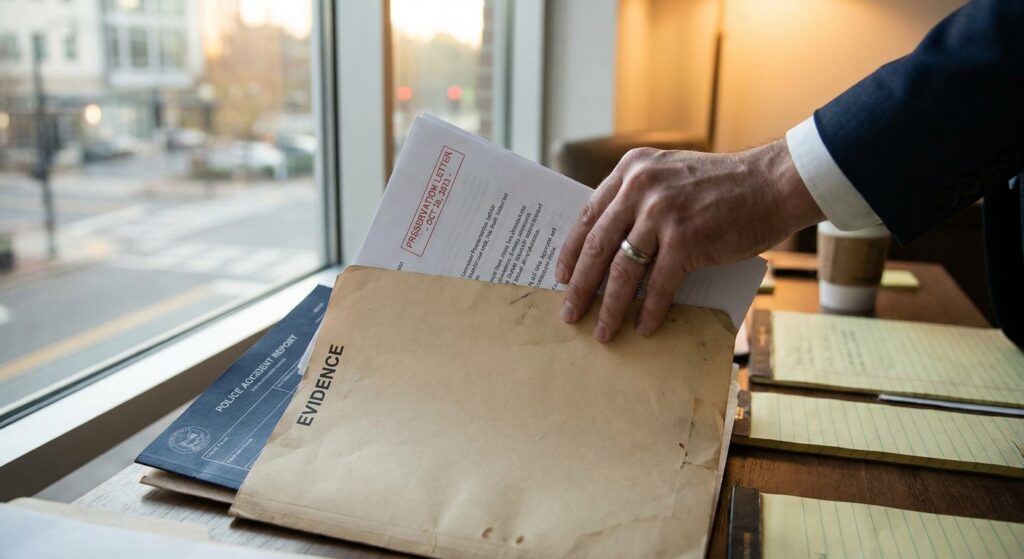

You signed a retainer agreement, and you have never heard the lawyer named on it speak. Every update about your crash comes from a different person. Each one gives a first name, reads a few lines from your file, and promises to “check with the attorney.” Now the adjuster has made an offer, and the real decision is not about the number. It is whether the car accident lawyer in Charlotte you hired is actually handling your case, or whether you need one like Carma Legal who will.
You deserve a clear way to make that decision. This guide covers what happens inside a high-volume injury firm, the one question that shows how any firm is built, the warning signs that your file is being processed instead of prepared, and what happens when you switch attorneys in North Carolina. I wrote it as the attorney who answers the phone at Carma Legal. Over 12 years I have represented clients, first at big law firms in Las Vegas and then at boutique firms in North Carolina, and I am licensed in both Nevada and North Carolina. People who call me in your position are not looking for a sales pitch. They want to know whether they are allowed to expect more. You are.
What Does It Mean When You Have Never Spoken to the Attorney on Your Retainer Agreement?
It usually means your case is moving through a volume system. Different staff members handle each stage, and no one with the authority to file a lawsuit is personally weighing your offer. The problem is how the firm is built, not any one person, and it explains most of what has frustrated you so far.
Many high-volume injury firms work like this. An intake paralegal signs you up, often on the first call. A case manager requests your medical records and bills, sends status updates, and takes your calls. A settlement coordinator presents the adjuster’s offer and asks whether you want to accept it. Each person handles one piece, so the firm can move a large number of files at once. What gets lost is the one thing your case needs most: a lawyer with litigation authority deciding whether the offer holds up against what a jury might award in the county where your case would be tried. In that model, the attorney whose name is on your retainer agreement may not read your file until the day before a hearing, if at all.
The staff are not the problem. Good paralegals are valuable, and under the American Bar Association’s Model Rule 5.3, the supervising lawyer is responsible for the work nonlawyer assistants do on a client’s matter. But supervising a file is different from knowing a client. A lawyer can approve hundreds of files a month and never learn that you cannot lift your child, that you have missed weeks of work, or that your neck pain started the morning after your crash on I-77.
I spent the first half of my career inside big law firms in Las Vegas, where most tasks ran through case managers and paralegals, so I understand why the model exists. It is efficient. It is also how clients become file numbers. I left that structure on purpose, and it is not the firm I want Carma Legal to become. If you have never spoken to your attorney, wanting to does not make you difficult. The real question is whether anyone on your case knows your story well enough to tell it to an adjuster, a mediator, or a jury.
The One Question That Exposes Whether Your Case Is on a Settlement-Only Track
That brings us to the most useful thing you can do before you hire a firm or switch to a new one. Ask this: “Will I speak directly to the attorney who will evaluate settlement offers and decide with me whether to file suit, or will I work with a case manager?” The answer tells you whether the firm is built to prepare cases for trial or to process them for volume settlement.
The question works because it is specific. “Will I have access to my lawyer?” is easy to answer with a cheerful yes. This question asks who evaluates the offer and who advises you on litigation. A firm that is prepared from the beginning will answer plainly: yes, you will talk to me, I will review every offer, and I will tell you whether I think a lawsuit may be in your interest. A volume firm tends to answer around the edges: our team is very responsive, your case manager will keep you updated, an attorney oversees every file. Each of those statements can be true while you still never speak to a lawyer.
Listen for three things in the answer:
- Does the person name the attorney?
- Does the answer say who evaluates the offer, not just who sends it to you?
- Does it mention filing suit at all?
A firm that never brings up litigation in the first conversation is often a firm that rarely files. That matters, because the decision is legally yours. North Carolina’s Rule of Professional Conduct 1.2 says a lawyer must follow the client’s decision on whether to settle. You cannot make that decision well if no lawyer has explained your options.
You can ask your current firm the same question. Call, ask it word for word, and write down what you hear. If the reply is that someone will pass it along, you have learned something important before an offer deadline forces your hand. At Carma Legal the answer is the same on every call. You are talking to the attorney who will evaluate your offers and advise you on whether to file suit, because that is the only way I know to give honest guidance on a case I am responsible for.
Why Can’t a Case Manager Tell You Whether a Settlement Offer Is Too Low?
A case manager cannot tell you whether an offer is too low because that is a legal judgment. Making it takes an attorney’s training, and acting on it takes an attorney’s authority. If you ask why the offer is so low and hear “we’ll pass that to the attorney,” you have learned that the person managing your file cannot evaluate damages or file suit. Your case is on a settlement-only track, whether or not that serves your injury.
Think about what evaluating an offer actually involves. Someone has to weigh liability and whether the insurer has accepted fault. Someone has to judge causation, meaning whether the crash caused your injuries, which is exactly what adjusters attack. Someone has to consider your injuries, future treatment, your ability to work, how your daily life has changed, and how severe the impact of the crash was. Then that person has to measure all of it against what a jury in the county where your case would be tried might do. Gathering records is a different skill. A case manager can tell you what the adjuster offered. Only an attorney can tell you what to do about it.
Here is a common example. Say the offer covers your emergency room visit and your physical therapy but ignores the shoulder surgery your orthopedist recommended last month. Should you accept, push back, or wait until your treatment plan is clearer? Should you prepare for mediation or a lawsuit? Those are legal questions with real consequences, and a case manager is not allowed to answer them. Insurers also look for gaps in care. If you put off seeing a doctor after the crash, an adjuster may use that delay to argue your injuries are minor and devalue your claim. That is why I tell every injured caller to get medical attention right away, to photograph their injuries and the damage to the vehicles, and not to talk with the insurance company or sign anything on their own.
At Carma Legal, you do not have to send your question through anyone. You can call, email, or text me directly for the whole case. After our first consultation, I usually ask clients to call me again the next day so we can go over everything a second time. A crash is traumatic, and all of this is new to you. Hearing it twice from the same attorney, with time to think in between, helps you make a decision you feel sure about.
What Does Attorney Access Look Like With a Car Accident Lawyer in Charlotte?
So what should real access look like? At Carma Legal, it means the attorney is the person you deal with from the first call to the final decision. I built the firm so that I personally speak with every client at the consultation, sign every representation agreement, evaluate every offer based on what a jury might award in the county where the case would be tried, and walk each client through the choice to accept or move into litigation.
Here is how the first stretch usually goes. Within the first 48 hours, we at Carma Legal have a consultation to decide whether you have a case. You talk with me, not a screener, and I analyze, investigate, and walk through the facts with you. If we move forward, you sign the representation agreement with me. Then I contact the at-fault insurance company and start working the claim. My first goal with the adjuster is getting them to accept liability, meaning accept fault for the crash. At the same time, I get the police report, collect property damage photos, and send preservation letters when the evidence calls for it.
Some cases need more. When liability or causation looks like it will be disputed, I may want the vehicle’s black box data. It can help show how fast someone was driving, whether the brakes were applied, and other facts that bear on who caused the crash and what caused your injuries. If video of the crash may exist, I want it preserved before it disappears. Once I decide that kind of evidence may help the investigation, I usually send a preservation letter immediately. Recognizing which cases need this step comes from more than a decade of practice, and I do not hand that decision off to anyone else.
Your first questions are usually practical. When do you get a rental car? When will your total loss be paid? Who handles the body shop? My staff and I at Carma Legal walk you through the property damage process step by step. Then the bigger questions come: what your case looks like, how attorney fees work, and how long it might take. I take the time to answer each one in detail. Throughout your case, you can call, email, or text me. That is what direct access to an attorney means here. It is not a slogan on a website.
The Warning Signs Your Current Firm Is Processing Your Case for Volume, Not Value
If you are already represented, you may be wondering how to tell which kind of firm you have. The clearest sign of an injury mill is simple: you cannot name the attorney handling your case, you have never spoken to one, and everyone you talk to gives only a first name with no title. If they told you they were paralegals or case managers, you would ask where the lawyer is.
That last pattern is worth noticing. Staff at a well-run firm have no reason to hide their roles. When nobody tells you their title, the firm is often trying to avoid the question you would ask next. Other signs tend to show up alongside it:
- You only hear from the firm when it needs a signature or a decision.
- Calls to the attorney go to voicemail and get returned by someone else.
- A settlement offer arrives with a short deadline and no explanation.
- No one has ever mentioned filing suit, mediation, or what trial would involve.
- Each update comes from a new person who has to re-read your file before talking to you.
The most serious warning sign is how an offer is presented. A proper explanation covers how the adjuster arrived at the number, whether it fairly accounts for your medical bills, injuries, and pain and suffering, whether a lawsuit could change the result, and what the timeline and cost of trial would be. If your firm sent you an offer without covering those points, it may have fallen short of its duty under North Carolina’s Rule of Professional Conduct 1.4. That rule requires a lawyer to explain a matter well enough for you to make informed decisions about your own case.
None of this means you did something wrong by signing with that firm. Most people hire a lawyer within days of a crash, while they are hurting, worried about their car, and fielding calls from adjusters. Volume firms are built to sign you quickly at exactly that moment. What matters now is what you do next. If several of these signs fit your situation, take that seriously, especially if an offer is already in front of you.
How Should a Settlement Offer Be Evaluated When Your Case Would Be Tried in Charlotte?
A settlement offer should be measured against what a jury might award in the county where your case would be tried. That depends on your injuries, how the crash has affected your life, your ability to work, and how hard the impact was. A generic national formula does not reflect local trial outcomes, because juries vary from one place to another.
Many people are surprised to learn that evaluating an offer is not a math equation. Adjusters like to make it look like one. They plug medical bills into a system, apply a figure, and send a number that looks official. But a jury does not use a formula. Jurors see a real person, hear how the injury changed that person’s work and family life, and weigh whether the treatment made sense. That is why venue matters so much. A crash on Providence Road that would go before a Mecklenburg County jury needs to be evaluated with that courtroom in mind, not a national average.
At Carma Legal I look at the medical records, the treatment still ahead, the effect on your work and daily life, the photos of the vehicles, and any evidence about liability and causation. I have handled major impacts that led to surgeries and years of recovery, and minor impacts that barely marked a vehicle, and I bring the same detail to each. If the offer does not fairly cover your medical bills, your injuries, and your pain and suffering, we talk about it directly, and I advise you on whether a lawsuit may be in your interest. If the insurer denies the claim outright, that may be a strong reason to move into litigation.
I will not tell you what your case is worth on the first call, and you should be careful of anyone who does. Every case is factually different. Asking a lawyer to put a figure on a case before reviewing it is like asking a doctor how they will diagnose and treat a patient they have not examined. I would rather be candid with someone than tell them what they want to hear. Clear communication means telling you what I know, what I still need to learn, and when I expect to know it.
Will Switching Attorneys in North Carolina Reset Your Case or Cost You Twice?
No. Switching attorneys does not reset your case or throw away the work already done. Your medical records, police report, and demand letters move to the new firm. North Carolina’s Rule of Professional Conduct 1.16 lets you end a representation at any time, and the outgoing firm must promptly return your file and any unearned fees. Switching is a protected right, not a penalty.
It may feel like leaving will make everything worse. Maybe you worry the insurer will see it as weakness, or that you will have to start your treatment records over, or that you are breaking some rule. Those fears are understandable, and they are exactly what keeps people in firms that are not serving them. In practice, if your current firm has done little more than request records and forward a low offer, you have lost very little time. What you gain is an attorney who will look at whether your case should go further, including to trial.
The process is simpler than most people expect:
- You meet with the new attorney and decide whether to move forward.
- You sign a new representation agreement.
- The new attorney notifies your former firm in writing and asks for your complete file.
- The new attorney tells the insurance company who now represents you, so the adjuster contacts the right person from that point on.
You do not have to have an awkward phone call with your old firm unless you want to.
Two practical points matter here. On fees, you do not pay two full contingency fees. Any fee the prior firm may claim for work it actually did is typically worked out between the firms from the final recovery, and your new attorney should explain how that applies to your case before you sign. On timing, North Carolina generally gives you three years from the date of injury to file a personal injury lawsuit under N.C. Gen. Stat. § 1-52. If your crash happened a while ago, do not wait to make this decision, because a new attorney needs time to prepare.
Why Does Carma Legal Limit the Number of Cases It Takes?
All of this raises a fair question: how can one attorney actually stay this involved? Carma Legal limits its caseload so the attorney can personally handle every client. You see my face on the website, you hear my voice when you call, and I manage every part of your case with open communication from start to finish. I intentionally choose the cases I take, and that choice is what makes direct access possible.
This was a deliberate decision about how to build the Carma Legal firm. A high-volume model depends on staff carrying most of the client contact. I prefer to be boots on the ground and available through the entire experience. A smaller practice lets me analyze, investigate, and walk through each case with the person it belongs to. I want to be able to tell my client’s story because I actually know their story. I give a crash that needed surgery and years of recovery the same attention as one where the car barely shows damage, because both clients deserve a lawyer who knows their file.
Carma Legal works on a contingency basis. You do not pay attorney fees upfront, and the fee comes from the recovery. The full terms are in the representation agreement, and I explain them before you sign. A contingency fee also means our interests are aligned. Beyond that, North Carolina’s Rule of Professional Conduct 1.3 requires reasonable diligence, and every lawyer owes clients a duty of loyalty and zealous advocacy. If moving into litigation and going to trial may get you a better result, I will advise you of that. The final decision to file suit is always yours, never mine. No attorney can promise how a case will end, but you should always know where it stands and why.
Carma Legal serves injured people from offices in Charlotte, NC, and Mesa, AZ. The North Carolina rules in this guide apply to Charlotte cases. The approach is the same in both places: direct access to an attorney, honest guidance, clear communication, and a case prepared from the beginning.
Questions to Ask Before You Switch Car Accident Lawyers in Charlotte
These are the questions people ask most often when they call about switching, with direct answers.
Can I switch lawyers after I already signed a retainer agreement?
Yes. North Carolina Rule of Professional Conduct 1.16 lets you end a representation at any time. Your former firm must promptly return your file and refund any unearned fees. Your new attorney can handle the written notice for you, so you do not need a difficult conversation with the old firm.
How do I know if I am working with a paralegal or a lawyer at my current firm?
Ask directly: “Am I speaking to the attorney who will evaluate settlement offers and advise me on whether to file suit?” If the person dodges the question or says they will pass it to the attorney, you have your answer. A lawyer will simply say yes and give you their name.
What should a lawyer explain before I accept a settlement offer?
Your attorney should explain how the offer was calculated, whether it fairly covers your medical bills, injuries, and pain and suffering given how a jury in your county might view the case, whether a lawsuit could change the result, and what the timeline and cost of trial would be. North Carolina Rule 1.4 requires enough explanation for you to make an informed decision.
Will switching attorneys delay my car accident case?
Usually very little. Medical records, police reports, and demand letters transfer to the new firm. If your current firm has only collected records and forwarded an offer, almost no time is lost. Keep North Carolina’s three-year filing deadline in mind, and do not wait until it is close.
Do I have to pay a lawyer upfront?
Most personal injury attorneys, including Carma Legal, work on contingency. You do not pay attorney fees upfront, and the fee comes out of any recovery. Ask any firm to explain its representation agreement in plain language before you sign, including how case costs are handled.
How often should I hear from my lawyer during my case?
You should be able to reach your attorney directly by phone, email, or text. Your attorney should personally explain every settlement offer and every litigation decision rather than handing that conversation to a case manager. At Carma Legal, clients reach the attorney directly for the entire case.
Find Out Who Is Actually Handling Your Case
The fastest way to know whether your case is being prepared or just processed is to talk with an attorney who will review it personally. Call Carma Legal at 702-934-2228 for a consultation. You will speak directly with the attorney who will handle your case, evaluate every settlement offer based on what a jury might award in the county where your case would be tried, and walk you through the choice to accept or move into litigation. You can also learn more at carmalegal.com.
Before you call, do one thing. Find your retainer agreement and the most recent offer letter, and look at the attorney’s name on the signature line. If you have never heard that person’s voice, that is the first thing to fix, and you can fix it today.
Ready to Speak Directly With Your Attorney?
You deserve more than a relay system when your recovery and financial future are on the line after a crash. At Carma Legal, every initial conversation puts you directly in contact with an experienced attorney who will personally handle your case from start to finish. If you’re ready to work with a lawyer who answers your questions themselves, not through an intermediary, we’re here to listen.
Case outcomes depend on many factors unique to each matter. This article describes a general approach and does not predict results in any particular case.