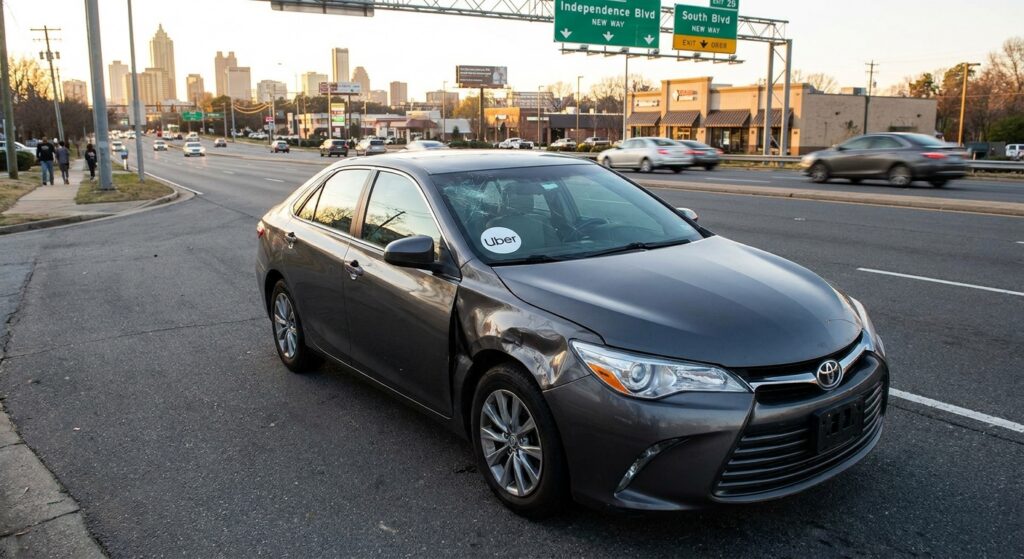

You are trying to decide whether this is a lawyer situation or a handle-it-yourself situation, and the advice you are getting points both ways. The other driver’s insurance company has been polite. Your car is in the shop or waiting on a total-loss decision. Maybe you feel fine, or maybe your neck has been stiff since the crash and you keep telling yourself it will pass. When people call Carma Legal with this question, I give them the same honest test every time: were you hurt? If nobody was injured and all you have is a damaged car, you may be able to handle the claim on your own. If you were injured, you may want to consider a lawyer for car accident injuries, and in North Carolina the reason goes well beyond the size of your medical bills.
I’m Nick Anderson, the attorney at Carma Legal. This guide covers where that line sits, why North Carolina’s fault rule changes the math, what a lawyer actually does once you hire one, what it costs, and how long you have to act. Carma Legal serves injured people in Charlotte, NC and Mesa, AZ, so where the law in those two states differs, I will tell you.
If Only Your Car Was Damaged, You May Not Need Me
If no one was hurt and the claim is only about repairing or replacing your vehicle, you may be able to handle it on your own. A property damage claim mostly comes down to repair estimates, photos, a rental car, and a fair valuation of your vehicle.
That is the same line Carma Legal draws for every caller. A crash with no injuries and only vehicle damage is often something you can manage without me. Once someone in the car is hurt, my advice typically flips, and I tell you that you may want representation. I would rather be candid with you than sign up a case where I cannot add real value.
Here is what handling it yourself looks like. You get a repair estimate from a shop you trust, and you keep every receipt for towing, storage, and rental costs. You take clear photos of the damage before repairs start. If the insurer says your car is a total loss, you compare its offer to listings for similar vehicles with similar miles and features, and you push back in writing if the number is low. One caution: read any property damage release before you sign it, and make sure it covers only your vehicle, not any bodily injury claim.
Picture someone backing into your parked car while you are inside a store. Nobody was in the car, nobody was hurt, and fault is not in question. That is a claim most people can manage. The picture changes the moment anyone in your car gets hurt, including a passenger or a child. Injury claims bring medical records, health insurance reimbursement, future care, and fault disputes into play, and that is where a mistake can cost you the whole claim.
Is It Worth Hiring an Attorney for a Car Accident in Charlotte?
If you were injured, in many cases you may want to consider it. North Carolina is one of the few places where a single successful argument that you shared any fault wipes out your entire claim, and the person looking for that argument is a trained insurance adjuster. You pay nothing upfront under a contingency fee, so the real question is whether you want someone on your side who is prepared from the beginning.
Think about what you are up against if you go alone. The adjuster handles claims like yours every day. You are handling one for the first time, while you are in pain, missing work, and trying to keep up with doctor visits. Every phone call gives the adjuster a chance to gather something that suggests you were partly to blame: you were going a little fast, you looked away, you changed lanes. In most states, that kind of detail lowers what you recover. In North Carolina, it can end your case.
Injury claims also require proof you may not know how to build. You need evidence of how the crash happened, records that connect your injuries to the crash, and an honest picture of how those injuries affect your daily life. If the insurer will not pay fair value, you need a case that can be presented in front of a jury.
That does not mean every injured person has a case I will take, and that is what the consultation is for. At Carma Legal, you get honest guidance about whether your claim may be able to survive North Carolina’s fault rule before you sign anything.
How Does North Carolina’s Contributory Negligence Rule Affect My Car Accident Case?
Under North Carolina’s contributory negligence rule, if you are found even slightly at fault for the crash, you recover nothing from the other driver, outside narrow exceptions like the last clear chance doctrine. North Carolina shares this all-or-nothing rule with only a handful of jurisdictions: Alabama, Maryland, Virginia, and Washington, D.C.
That rule shapes everything about how an injury claim plays out in Charlotte. Insurers know that proving you were 1 percent responsible is just as good for them as proving you were 50 percent responsible. So the fight is often not about how badly you were hurt. It is about whether there is any version of events in which you share the blame.
At Carma Legal, I treat contributory negligence as the hardest hurdle in a Charlotte injury case, and I size it up in the very first conversation. My decision to accept your case turns on a single test: could I stand in front of a jury and show that the other driver bore all of the fault for this crash? When I cannot see a strong path to that proof, I will likely decline. If I tell you no, I tell you why, because that is more useful to you than a firm that signs your case and lets it fall apart months later.
Callers sometimes ask Carma Legal which medical records they should gather to beat a shared-fault argument. The honest answer is that your medical records do not settle who caused the crash at all. They show what happened to your body, not who was to blame. Fault gets proven with other evidence: the police report, photos of the scene and vehicles, witness statements, video, and the physical facts of where each car was and how they hit.
Time matters here too. Under North Carolina General Statutes § 1-52, you have three years to file a personal injury lawsuit, but the evidence that proves zero fault starts fading much sooner.
If your crash happened in or around Mesa, the rule is different. Arizona follows pure comparative fault under A.R.S. § 12-2505, so your share of fault reduces your recovery instead of erasing it. Fault still matters in Arizona, but it does not carry the same all-or-nothing risk.
Why a Sore Neck Today Can Be a Bigger Injury Next Week
Fault is only half the picture. The other half is your injury, and some crash injuries do not show their full extent right away. That is why settling early, before you know how badly you are hurt, is one of the most costly mistakes you can make. Once you sign a release, your claim is generally over, even if your injury turns out to be far worse than you thought.
Adrenaline after a crash can mask pain for hours. Stiffness that seems minor on the first day can turn into pain that runs down an arm or leg as swelling sets in, which can point to a disc or nerve problem. Head injuries can be just as slow to reveal themselves. The Mayo Clinic notes that some concussion symptoms may appear right away while others are delayed by hours or days after the injury.
Now think about what you said in those first days. If you told the other driver’s adjuster you felt fine, that statement can follow you. If you accepted a quick check to cover an emergency room visit, you may have signed away your right to claim the surgery or physical therapy you need later. Early offers tend to arrive before the full medical picture exists, and that timing works in the insurer’s favor, not yours.
The safest path is simple. Get checked by a doctor promptly, even if you feel mostly okay, and follow the treatment plan you are given. Tell your providers about every symptom, including the ones that seem small. And do not sign a release or settle any injury claim until you understand how badly you were hurt and what your recovery may require.
What Does a Lawyer for Car Accident Injuries Actually Do for You?
A lawyer for car accident injuries takes over the parts of your claim that can sink it: proving fault, documenting your injuries as they develop, handling the adjuster, and getting the case ready for a jury if the insurer will not pay fair value. You focus on recovering while the attorney builds the case.
When you hire Carma Legal, my attention goes to you, not to the adjuster. What the insurance company wants or asks for does not drive my decisions. Two things do: whether you can heal from what the crash did to you, and whether we gather every piece of evidence needed to present the claim for the insurer’s driver’s conduct.
People hear “holding the insurance company accountable” and picture a battle from day one. That is not usually how it works. In many cases I never have to force the issue. It comes into play when the insurer denies the claim or will not pay what the claim may be worth. At that point, being willing to keep pushing, into a lawsuit and toward a jury if needed, is what can change its position. That is why the case gets prepared from the beginning, not after the insurer says no.
The work runs in a clear order. First comes the evaluation of fault, which is the gate in North Carolina. Next is evidence gathering: the crash report, scene photos, witnesses, and anything else that shows how the collision happened. While you treat, your medical records and bills are collected so the claim reflects your actual injuries and the causation between the crash and those injuries is documented. Then comes the demand to the insurer, negotiation with the adjuster, and, when needed, mediation or a lawsuit.
The difference you will feel most is who you talk to. With Carma Legal, you get direct access to an attorney. When you call, you hear my voice, not a paralegal’s or an intermediary’s. I personally keep in contact with you, I manage every aspect of your case, and communication stays open from start to finish, so your questions get answered as they come up. At large volume firms, clients become file numbers handed from one case manager to the next. That is not the firm I want Carma Legal to become. If your case ends up in front of a jury, I want to be able to tell your story because I actually know your story.
What Should I Do Immediately After a Car Accident in Charlotte?
Whether or not you have hired anyone yet, the first hours after a crash matter. Your first priorities are your health, your safety, and preserving the evidence that proves the other driver was at fault. Because North Carolina bars recovery if you share any fault, what you do in the first hours and days carries extra weight.
- Check for injuries and call 911. Get medical help for anyone who needs it and move to a safe spot if you can.
- Report the crash to police. An officer’s report records the scene, the drivers, and often statements made on the spot.
- Photograph everything. Capture both vehicles, where they came to rest, traffic signals, signs, skid marks, road conditions, and your injuries.
- Get witness names and phone numbers. An independent witness can be strong proof of complete fault.
- Exchange information, but do not argue about fault. Share insurance and contact details. Avoid apologizing or guessing about what happened, since a polite “I’m sorry” can be framed as an admission.
- See a doctor promptly, even if you feel okay. Choosing a doctor is your decision, not your attorney’s, and Carma Legal leaves it with you. The right provider depends on your specific injuries, where you live, where you work, and which doctors are available close to where you are each day. Pick care you can actually keep up with.
- Be careful with the other driver’s insurer. You do not have to give a recorded statement right away. Talk to a lawyer first.
- Keep a record of your losses. Save medical bills, receipts, rental car costs, and notes about missed work and daily limits.
- Do not sign anything that covers your injuries until you get honest guidance. A release is usually final.
What Types of Car Accident Injuries Does Carma Legal Handle?
Carma Legal handles injury claims from car crashes across the range of harm a collision can cause, from soft tissue damage to fatal crashes. These include:
- Soft tissue injuries such as whiplash, sprains, and strains
- Broken bones
- Herniated and bulging discs
- Concussions and traumatic brain injuries
- Spinal cord injuries
- Injuries from rideshare crashes, whether you were a passenger, another driver, or a pedestrian
- Fatal crashes, where a family brings a wrongful death claim
The crashes behind these injuries vary just as much: rear-end collisions, intersection and T-bone crashes, lane-change and merge collisions on the interstate, hit-and-run crashes, and collisions with drivers who carry little or no insurance.
In North Carolina, though, the type of injury never answers the first question. A serious spinal injury does not overcome a fault problem, and a modest soft tissue injury with clear proof of complete fault may still be worth pursuing. That is why every Carma Legal case starts with how the crash happened before it moves to what the crash did to you.
You also will not get a “typical” settlement range from Carma Legal for a broken bone versus a herniated disc. No such standard figure exists in my practice, as each case is different. Each injury produces its own level of pain, its own restrictions, and its own disruption to your daily life, so anyone who gives you a number before knowing those details is guessing.
What Percentage Do Lawyers Take From a Car Accident Settlement?
Most car accident lawyers charge a contingency fee of roughly 33 to 40 percent of the settlement or verdict, and you pay no attorney’s fee unless money is recovered. Carma Legal does not use a special or unusual arrangement; its fee is the standard contingency structure.
Where a fee falls in that range usually depends on how far the case goes. Many agreements set a lower percentage if the claim resolves before a lawsuit and a higher one if the case is filed in court or goes to trial, because litigation takes far more time and work. Whatever the percentage, it should be written plainly in your agreement before any work begins, with nothing left vague.
The contingency model exists for people in exactly your position. After a crash you may be out of work, facing medical bills, and paying for a rental car, and hourly billing would put a lawyer out of reach for most injured people. With a contingency fee, the attorney’s payment depends on getting a recovery for you. That also gives the attorney a reason to be honest at the start about whether your case can win, and under North Carolina’s fault rule, that honesty is part of the value.
What Is the Cost of a Car Accident Attorney in Charlotte, NC?
Hiring a car accident attorney in Charlotte costs nothing upfront. Under a contingency fee, the lawyer is paid a percentage of what is recovered, and if there is no recovery, there is no attorney’s fee. At Carma Legal, the consultation is free and the fee is the standard contingency arrangement.
North Carolina also protects you in how that fee gets set up. Under the North Carolina Rules of Professional Conduct, Rule 1.5, a contingency fee agreement must be in writing and signed by the client. It has to state how the fee is calculated, including the percentage if the case settles, goes to trial, or is appealed. It must also list which costs will come out of the recovery and whether they come out before or after the fee is figured.
That last detail matters more than most people realize. Read your agreement for three things: the percentage at each stage of the case, how case expenses are handled, and what happens if you part ways with the attorney before the case ends. If anything is unclear, ask before you sign. A lawyer who explains the fee clearly at the start is usually one who will communicate clearly later.
How Much Does it Cost to Hire a Car Accident Lawyer In Charlotte?
The attorney’s fee is a percentage of the recovery, but the number that matters to you is what you take home after the fee, case expenses, and any medical bills or liens are paid. Ask any lawyer you are considering to walk you through how those pieces fit together.
Case expenses are separate from the fee. They can include the cost of getting medical records, court filing fees, deposition transcripts, and, in cases headed to trial, expert witnesses. A claim that resolves early tends to carry far fewer expenses than one that goes through a full lawsuit.
Medical bills come into play too. If your health insurance paid for crash-related treatment, it may have a right to be paid back from your settlement, and unpaid providers may also have claims against the recovery. Part of an attorney’s job is sorting out those obligations so you are not surprised at the end.
North Carolina’s Rule 1.5 requires a lawyer working on contingency to give you a written statement when the case concludes, showing the outcome, what was paid out, and how your share was calculated. At Carma Legal, you can ask me directly about any line on that statement. Clear communication on money is part of the job, not an extra.
What is the cost of a personal injury lawyer?
Most personal injury lawyers, including Carma Legal, work on the same contingency model for every kind of injury claim: no upfront fee, and a percentage of the recovery only if money is recovered. That applies whether your claim comes from a car crash, a rideshare collision, or another accident, in Charlotte or Mesa.
The bigger question is the cost of going without one. In North Carolina, a single misstep on fault, such as a recorded statement that hints you were distracted, can end a claim entirely. No fee arrangement can fix a claim that has already been lost.
There is also a practical limit people rarely hear about. In many of Carma Legal’s injury cases, the demand sent to the insurer asks for the policy limits. The usual problem is not convincing the insurer that the full policy is justified. It is that the available coverage falls short of what the injuries require. Knowing that early changes the strategy: it means identifying every policy that may apply and building the demand with that limit in mind.
That is why the conversation about cost should also be a conversation about your options. A good consultation tells you whether your case may be able to survive the fault rule, what insurance may be available, and what the process will look like from evaluation to negotiation.
How Much Time Do I Have to File a Car Accident Lawsuit in North Carolina?
In North Carolina, you generally have three years from the date of the crash to file a personal injury lawsuit under N.C.G.S. § 1-52, and two years from the date of death for a wrongful death claim under N.C.G.S. § 1-53. In Arizona, the deadline for most injury and wrongful death claims is two years under A.R.S. § 12-542.
Miss that deadline and the court will almost always dismiss your case, no matter how strong it was. The insurance company knows this, and a claim that drifts toward the deadline loses negotiating strength along the way.
Three years sounds like plenty of time, but in a contributory negligence state the clock that matters most is the one on your evidence. Witnesses move and forget details. Nearby businesses record over their security video. Vehicles get repaired or scrapped, and the physical proof of how they collided disappears with them. The sooner a fault investigation starts, the more there is to work with.
Claims involving a government vehicle or public road defect can also carry shorter deadlines or special notice rules. Arizona in particular requires a formal notice of claim against public entities well before the two-year mark. If a city, county, or state vehicle was involved, do not assume the standard deadline applies to you.
Serious Crashes on I-77 and Independence Parkway Still Come Down to Proof of Fault
Among the Charlotte crashes that reach Carma Legal, a large share happen on I-77 or Independence Parkway. That is my own observation from my caseload, not a statistic, and I do not have data ranking which Charlotte roads produce the most serious injuries.
What these crashes share is the kind of fault question they raise. On busy multi-lane roads, collisions often involve lane changes, merges, sudden braking, and following distance. Each of those creates room for the other side to claim you contributed, even a little. Did you signal long enough? Were you in the other driver’s blind spot? Did you brake harder than you needed to?
In a contributory negligence state, an adjuster has every reason to explore those questions, because any shared fault ends the insurer’s obligation to pay. The answer is evidence gathered early: dashcam footage, traffic camera video if it exists, witness accounts, the police report, and the damage pattern on both vehicles, which can show the angle and order of impact.
If you were hurt in a crash on a stretch like this and the other side is already suggesting you share the blame, that is your signal to get legal help now, not after you have given a recorded statement.
Talk to the Attorney Who Will Actually Handle Your Case
If you were injured in a car accident in Charlotte or Mesa, call Carma Legal at 702-934-2228 for a free consultation to find out whether your case may be able to overcome North Carolina’s strict fault rules. You will speak with me, the attorney, about what happened, and you will get a straight answer about whether I may be able to prove the other driver was completely at fault.
Carma Legal’s Charlotte office is at 2015 Ayrsley Town Blvd, Suite 202 Office Number 252, Charlotte, NC 28273, and the firm also represents injured people in Mesa, Arizona. You do not pay anything to have that first conversation, and you do not pay an attorney’s fee unless there is a recovery.
One concrete thing to do before you call anyone else: if the other driver’s insurer asks for a recorded statement, politely decline until you have spoken with a lawyer. In North Carolina, that single conversation is one of the easiest places to lose a claim, and one of the easiest mistakes to avoid.
Let’s Talk About Your Next Steps
If you’re weighing whether to handle your car accident claim alone or work with someone who knows the process inside and out, that hesitation makes sense. The insurance companies have their own legal teams working to minimize what they pay, and you deserve someone equally committed to protecting your interests. Carma Legal offers personal injury representation in Charlotte and Mesa, and a brief conversation can help you understand what your case might involve and whether legal support is right for your situation.
Every case is different, and results depend on the specific facts and circumstances of each individual matter.