
A Carma Legal client called me from a parking lot last week, five days after a rear-end collision on I-77, asking if she was allowed to refuse the insurance adjuster’s third call requesting a recorded statement. She thought saying no would make her look guilty or uncooperative. I told her she had already used one of her most important legal rights: the right to stop talking to the other driver’s insurer and let an attorney handle it instead. Many people give that right away in the first phone call without realizing it. Understanding your injury victim legal rights before that call happens can affect the trajectory of a claim in the first few weeks.
What Injury Victim Legal Rights Do You Have After an Accident?
After an accident, you have the legal right to pursue compensation for your medical bills, your lost wages, your property damage, and your pain and suffering. You also have the right to control who you speak to, what evidence gets preserved, when and how you seek medical care, and whether you accept a settlement offer or take your case to trial.
Those rights exist whether the crash happened on I-77 near Charlotte or the Loop 202 near Mesa. The problem is that a right you do not know about is a right you cannot use. Most people I talk to have never had to navigate the justice system before. They sometimes assume the insurance company will treat them fairly because they were not at fault, and they sometimes assume there is plenty of time to sort everything out. Both assumptions can be costly.
Legal guidance points injured people in the same direction every time: get advice early, before decisions get made for you. Here is the part that matters. These rights mean nothing if you do not protect them in the critical first days after the crash. That is where I focus, and that is what the rest of this guide walks through.
How Do You Protect Evidence Before It Disappears?
You have the right to preserve the evidence your claim depends on, and you have to act fast, because the insurance company will not do this work for you. Evidence starts vanishing within hours, not weeks.
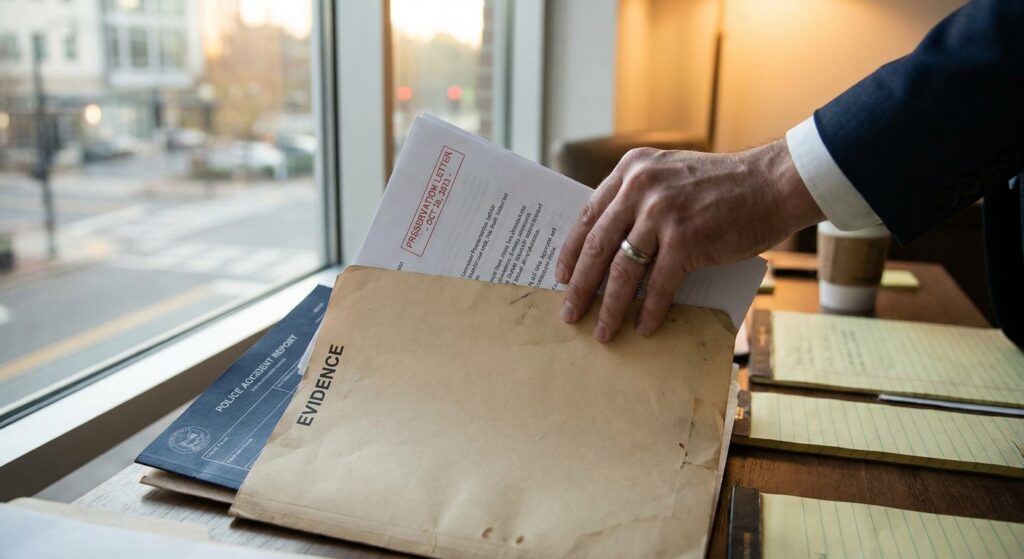
In the first 48 hours of a Carma Legal case, here is what I do. I obtain the police report and 911 records. I identify and contact witnesses, calling them directly and having them send a confirmed email statement that I save as a PDF with the metadata intact, so there is no question later about when the statement was made. I pull satellite images. I look for surveillance or traffic-camera footage. I send preservation letters quickly, in order to keep video and other evidence from being overwritten or destroyed. My rule is simple: preserve first, investigate second, escalate when necessary.
Timing is the whole game here. Surveillance and traffic-camera footage is often recorded over within 30 to 90 days. Witness memories fade within weeks, and details that felt permanent get fuzzy. Physical evidence like skid marks, debris, and impact locations gets cleared from the roadway within hours. In a T-bone or a left-turn case, where fault is disputed and there may be no clear citation on the police report, locking down those witness statements before memories fade can be critical to the case.
For serious crashes handled by Carma Legal, I preserve black box and event data recorder information from the vehicles and, when it is warranted, bring in an accident-reconstruction professional. The insurance company benefits every time a piece of proof goes missing. Preparation from the beginning is not a slogan for me. It is how I approach protecting a victim’s claim.
Can You Refuse the Insurance Company’s Recorded Statement?
Yes. You are not required to give a recorded statement to the at-fault driver’s insurance company, you are not required to sign medical authorizations that let them pull your entire health history, and you are not required to accept their first offer. Saying no does not make you look uncooperative. It protects your claim.
In the first 48 hours, I tell my Carma Legal clients not to speak to the insurance company themselves and not to sign anything. The reason is practical. A statement you give in that first friendly-sounding call can be used to reduce or challenge your claim weeks later. The adjuster asks “Are you hurt?” and “How did it happen?” while you are still shaken, still in pain, and still missing pieces of the picture. You answer honestly, because you have nothing to hide, and then those answers get turned against you.
The adjuster will make the call sound mandatory, urgent, and cooperative. It is none of those things. The at-fault driver’s insurer works for the at-fault driver’s insurer. That is not an insult, it is just the arrangement. Once I am on the file, all of that communication comes through me, which is exactly why the woman in that parking lot was right to stop answering. Handing off that contact is one of the ways to lower your stress and avoid unintentionally harming your own case.
I worked on the defense side for insurance companies earlier in my career before Carma Legal, so I know the tactics because I used to be on the other end of them. Most victims never see them coming.
Why the First Settlement Offer May Not Reflect the Full Value of Your Claim
You have the right to full compensation, and the first number the insurer puts in front of you may not reflect it. That first offer is a starting point designed to close your file cheaply, not necessarily a fair measure of what you lost.
Full compensation covers more than the bills sitting on your kitchen table. It includes past and future medical care, lost wages, reduced earning capacity if the injury affects your ability to work long term, property damage, and pain and suffering. In one Carma Legal case I handled, I pushed back on the insurer’s initial offer with legal research and data-driven evidence, including jury verdicts and settlements from similar cases in the same county. That raised the number, but I still did not believe it fairly compensated the client (though outcomes vary from case to case), so we kept pushing and took the insurer to mediation, where we were able to secure an offer that exceeded what the client expected.
Comparable-case data changes the conversation. It stops being an arbitrary argument over numbers and becomes a discussion about what the insurer could realistically face in front of a jury in that venue, given that jury pool. Here are comparable cases, here are the similarities, here are the differences. That is a far stronger position than “we want more.” If the insurer refuses to pay what your claim may be worth, you have the right to negotiate and, if needed, the right to take your case to court.
What If Your Symptoms Show Up Days After the Crash?
You have the right to receive medical treatment even if you felt fine at the scene, and you should get it as soon as symptoms appear. Delayed pain is common, especially with soft-tissue and head injuries, and gaps in treatment give insurers an opening to argue your injury was not caused by the crash.
Adrenaline hides a lot in the first hours. People walk away from a collision thinking they are lucky, then wake up two days later with a stiff neck, headaches, or back pain that keeps getting worse. That is not unusual. It is how the body sometimes responds. The trouble is that when treatment is delayed, the insurer may claim the injury was unrelated, or that if you were really hurt you would have gone to a doctor right away. That is why I push Carma Legal clients to seek medical attention quickly and to follow up with specialists when new symptoms develop.
You have the right to treatment that addresses the full scope of your injuries, not just what the insurance company decides to authorize. You also have the right to have the causation and permanency of your injuries documented properly, which is what connects the crash to the harm.
There is a legal clock, too. In North Carolina, you generally have three years from the date of the accident to file a personal injury claim under North Carolina General Statutes section 1-52. Different states set different deadlines, so the exact window depends on where your crash happened, and that is one of the first things I confirm on a Carma Legal call. Either way, the practical deadlines come much sooner, because evidence fades and insurers may argue that any delay proves the injury was minor. Do not skip care to save your claim. Getting treated and building the record go together.
Your Right to Reach the Attorney Directly, With No Money Upfront
You have the right to work directly with the attorney handling your case, and you have the right to representation at no upfront cost. Both matter most in the first week, when time-sensitive decisions cannot wait on a callback.
I run a smaller firm on purpose at Carma Legal. We are very intentional about the cases we take, because that is what lets me give each client full care and attention. When you call, you speak to me, the attorney, not just staff. Within the first 48 hours there is a consult to determine whether you have a case, you sign the representation agreement, and my office reaches out to the at-fault insurance company and starts working the claim, beginning with getting them to accept liability. Throughout all of it, you have direct access to me to analyze, investigate, and walk through every step. I am boots on the ground and available the whole way.
I work this way for a reason. At big firms, tasks get managed through case managers and paralegals, clients become file numbers, and the person whose name is on the retainer is someone you never actually speak to. That is not the firm I want Carma Legal to become. I want to be able to tell my client’s story because I actually know their story. I would rather be candid with someone from day one than hand them off and hope it works out.
On cost, Carma Legal personal injury representation runs on a contingency fee. You pay nothing upfront, and the fee comes only as an agreed percentage of your recovery if we win. If there is no recovery, you do not owe an attorney fee. That structure exists so that being injured and short on money does not shut you out of protecting your rights.
I am licensed in North Carolina and Nevada, I have spent roughly 12 years handling injury claims, I have represented thousands of clients, and I have worked both boutique firms in North Carolina and big law in Las Vegas. Ethics rules keep me from calling myself an expert, so I will just say this: I have done this a long time, on both sides, and I can walk you through what is coming.
Common Questions About Injury Victim Legal Rights
Do I have to give a recorded statement to the other driver’s insurance company?
No. You have the right to decline a recorded statement and to let your attorney handle all communication with the at-fault driver’s insurer. Those early recorded answers are sometimes used later to reduce or challenge a claim, so the safest move is to route that contact through counsel from the start.
How long do I have to file a personal injury claim in North Carolina?
In North Carolina, you generally have three years from the date of the accident under North Carolina General Statutes section 1-52. The evidence deadlines come much sooner, because footage, witness memory, and physical proof at the scene disappear within days to weeks. Deadlines differ by state, so confirm your specific window early.
Can I still get compensation if I did not go to the hospital right after the accident?
You may be able to, but delayed treatment makes it harder to prove your injuries came from the crash. Insurers use treatment gaps to argue the injury was unrelated. See a doctor as soon as symptoms appear, and follow up with specialists if new pain develops in the days after.
What if the insurance company’s first settlement offer seems fair?
The first offer may not reflect the full value of a claim. You have the right to negotiate using comparable jury verdicts and settlements, and the right to take your case to court if the insurer refuses to pay what you believe you are owed. A fair-sounding number is sometimes a starting point built to close your file cheaply.
Do I have to pay a lawyer upfront to handle my injury claim?
No. Personal injury attorneys work on a contingency fee, which means you pay nothing upfront and the fee comes only as an agreed percentage of your recovery if you win. If there is no recovery, you do not owe an attorney fee.
What evidence should I collect right after an accident?
Photos of the scene, the vehicle damage, and your injuries, the contact information for any witnesses, the police report, and any nearby surveillance footage before it gets overwritten. If you are able, note skid marks, signal timing, and sight lines. Then get that material to an attorney who can send preservation letters fast.
Call Carma Legal today for a free consultation to protect your legal rights and preserve the evidence your claim depends on. We serve injured people across the Charlotte, NC and Mesa, AZ areas, and when you call, you talk to the attorney handling your case. The first move I make is preserving the proof that disappears the fastest, so the sooner we talk, the more of your claim we can protect.
Find Out What You’re Owed
If you’re uncertain whether your situation qualifies for compensation or how to move forward after an accident, you don’t have to figure it out alone. Carma Legal helps injury victims in Charlotte and Mesa understand their legal rights and pursue the recovery they deserve. A conversation with our team can clarify your options and help you take the next step with confidence.
Every case is different. The outcome described here reflects one client’s experience and does not predict results in other matters.