
A woman called me last Tuesday from a Panera parking lot on Providence Road, three weeks after signing with another Charlotte firm, asking a single question: “Is it normal that I’ve never once spoken to the lawyer whose name is on my retainer?” She had been rear-ended on I-77, her neck pain was getting worse, and every time she called the firm she got a different case manager who had to look up her file. She wanted to know if switching attorneys this early would hurt her case. I told her the truth at Carma Legal: staying with a firm where no attorney knows her name can create challenges far more significant than switching representation. If you are already signed and quietly wondering the same thing, the ten questions to ask a personal injury lawyer below are written for you, not for someone shopping for the first time.
I built Carma Legal to be the opposite of the firm that woman signed with. I have practiced for about 12 years, I am admitted in North Carolina and Nevada, and I spent years defending insurance companies before I ever represented injured people. That background is why I know what a well-run claim can look like from the inside, and where a claim may face challenges when nobody is truly minding it. Use these questions on your current firm, or on any firm you are considering next.
1. Who Will I Actually Talk To When I Call About My Case?
You may speak directly to the attorney handling your case, or you may speak with a case manager or staff member, depending on how that firm operates. If the answer is “a case manager will help you,” that tells you about how that firm’s communication is structured.
When someone calls Carma Legal, they typically reach me, the attorney, rather than staff standing between us. I keep the firm intentionally small for that reason. You see my face on the website, and you may hear my voice when you call in. I handle aspects of the file myself, and I stay in communication throughout, though I cannot predict exactly how each individual case will unfold. That is not a marketing promise, it is a structural choice about how many cases I take.
Compare that to the situation the caller from Providence Road described. Every call landed with a different person who had to pull up her file from scratch. Nobody there knew her name, her injury, or the timeline of her treatment. When clients become file numbers, small details that may matter can get missed, because the people answering the phone are managing volume.
Ask this first. Of all the questions to ask a personal injury lawyer, direct access to an attorney is the one that tells you whether the rest of the answers will mean anything.
2. What Evidence Will You Preserve in the First 48 Hours After My Crash?
Some firms move on objective evidence within days, because certain types of evidence can disappear. If a firm waits until settlement talks begin to investigate, some proof that could help your case may already be gone.
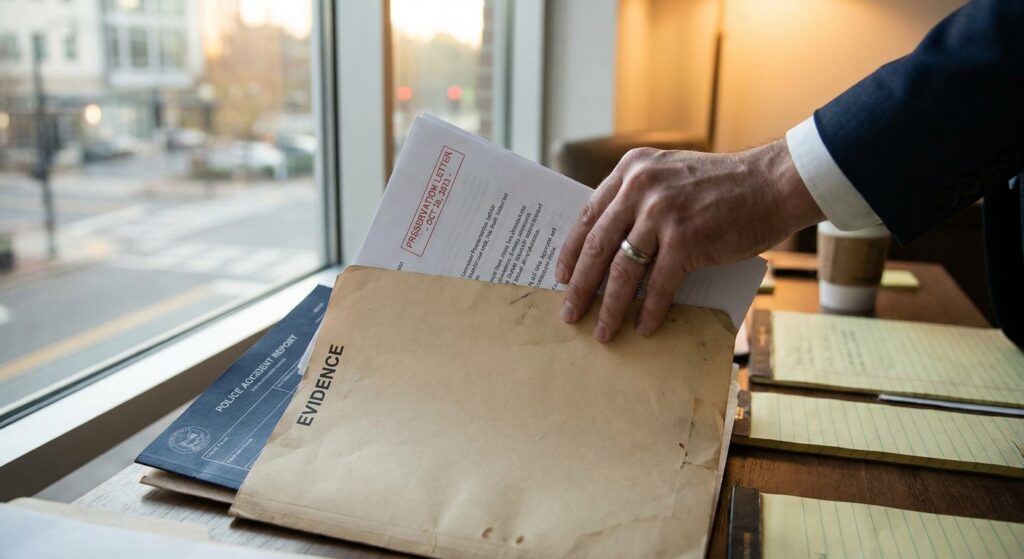
In the first weeks after a crash, my priority at Carma Legal is evidence that may vanish: the police report and 911 recordings, witness names and contact information, satellite images of the intersection, and surveillance or traffic-camera footage from nearby businesses, homes, and vehicles. I send preservation letters so video is not overwritten or a damaged vehicle is not repaired, sold, or salvaged before anyone reviews it. In crashes involving serious injuries, I work to preserve the black box, or event data recorder, which the National Highway Traffic Safety Administration describes as recording speed, braking, and other inputs in the seconds around impact.
Timing matters because footage does not sit forever. Many camera systems record over themselves on short cycles, and public traffic-signal data is subject to retention limits set by the North Carolina Department of Transportation. My approach at Carma Legal is simple: preserve first, investigate second, escalate when necessary. That order can help keep your case from being reduced to two drivers telling different stories with nothing to break the tie.
3. How Many Cases and Clients Are You Handling Right Now?
A lawyer’s honest caseload tells you whether they may have capacity to prepare your file individually or may need to manage many files simultaneously. Ask for a real number, and watch whether they hedge.
I choose my cases at Carma Legal intentionally so that each client can receive individualized attention through the experience. We are very intentional about the cases we take. That is not a limitation, it is the whole point. A high-volume firm may carry hundreds of open files per attorney, which can require delegating much of the actual work to paralegals and junior staff, with the named attorney signing clients and appearing at the end.
Think about what that means for the day-to-day work on your claim. Someone has to read your medical records closely enough to spot potential issues. Someone has to notice when the causation link between the crash and your symptoms may need a treating physician’s opinion. Those judgments are legal judgments, and they can be harder to execute when one attorney is stretched across a very large caseload.
When you ask this question, you are really asking whether there is room in this lawyer’s week for your case to receive individualized attention. If the number is large and the answer is vague, that may tell you something.
4. Have You Ever Represented Insurance Companies, and What Did You Learn from That Experience?
An attorney who has worked the defense side knows the insurer’s playbook from the inside. That is not a conflict, it is experience you may want on your side of the table.
Before I represented injured people at Carma Legal, I spent years defending claims on behalf of insurance companies. I have sat in the rooms where they decide what a claim is worth to them, how they build a reserve, and where they look to reduce value. There are tactics an adjuster uses that I have seen before. I am admitted in both North Carolina and Nevada, and across roughly 12 years I have worked in large firms in Las Vegas and boutique practices, representing many clients along the way.
That history shapes how I approach your file from day one. When an adjuster delays, minimizes an injury, or leans on a recorded statement you gave early, I recognize the move because I used to make it. Knowing how the other side may price risk helps me build the file in a way that may respond to that. Ask any lawyer you are considering whether they have that inside knowledge, and how they use it.
5. What Do You Do If the Insurance Company’s First Offer Comes In Too Low?
Some firms respond to a lowball offer with data. One approach is using comparable-case evidence: what juries in your venue have awarded on similar facts, when such information is available.
I had a Carma Legal client who received an offer that the client felt was low. Instead of simply demanding more, I pushed back with legal research and data-driven evidence, including jury verdicts and settlements from similar cases in the same county, where I could find them. That approach moved the offer. I still did not believe it fairly compensated the client, so we kept pushing and moved the insurer to mediation, where we secured an amount that the client felt was better. Using comparables can change the conversation from an argument over a number to a discussion about what the insurer could face before a jury, though outcomes depend heavily on the specific facts of each case.
The reason this approach may work is that adjusters price risk. When you can present comparable cases, the similarities and differences, and what a jury in this venue did in those cases, it can shift the negotiation. I refused to compromise on what I believed that claim was worth, and being willing to keep pushing can sometimes make a difference, though no outcome is guaranteed.
6. Will You Handle My Case Yourself, or Will It Be Passed to a Junior Attorney or Paralegal?
The lawyer you meet in the consultation may or may not be the same person who prepares your demand, negotiates your settlement, and stands up at trial if it comes to that. At many firms, delegation to staff is common practice.
The high-volume model often works like this: the named partner signs you, then paralegals and junior associates handle the day-to-day work, and you may not speak to a decision-making attorney again until the very end. That is not how I want Carma Legal to operate. I want to be able to tell my client’s story because I know their story, and you cannot know a story you were handed as a stack of forms.
Direct attorney involvement from intake through resolution matters most at the pressure points. The person who reviews your records, decides when treatment has reached a certain stage, drafts the demand, and reads the insurer’s response is ideally the same person who understands your full picture. When those tasks are split across staff, continuity can break, and continuity is where attention to detail lives.
Ask the lawyer to name, specifically, which parts of your case they will personally touch. The answer draws a clear line between different approaches to case management.
7. How Often Will I Hear From You, and How Will You Send Updates?
Some firms reach out to you proactively, while others may wait for you to initiate contact about your own claim. Set that expectation in writing before you sign.
The North Carolina State Bar Rules of Professional Conduct require attorneys to keep clients reasonably informed and to respond to reasonable requests for information. The challenge is how differently firms read the word “reasonably.” A high-volume shop may treat it as responding only when you call, which is why the caller from Providence Road felt invisible. She was technically getting answers, but only when she initiated every single conversation.
My Carma Legal clients can email, text, or call me directly throughout their case, and I work to stay in touch as things move, though the frequency of communication may vary depending on what is happening at each stage. In the first days after a crash I often tell people to call back the next day and go over everything again, because it is a traumatic, new situation and nobody absorbs it all at once. Clear communication is not a courtesy add-on, it is how I work to reduce your stress and keep you making informed decisions.
When you ask this question, listen for specifics. A firm that says “we’ll update you at milestones and you can reach me directly in between” is describing a relationship. A firm that just says “call us anytime” is describing a phone line.
8. Fee Transparency: The Questions to Ask a Personal Injury Lawyer About Costs
This is the topic that protects your recovery directly, so the lawyer should explain the fee and the costs in plain language, in writing, before you sign anything. Nothing about the money should surprise you at settlement time.
Carma Legal works on contingency, which means no upfront fees. You do not pay attorney fees out of pocket to start, and the fee comes as an agreed percentage of the recovery, if there is a recovery. The consultation is free. Beyond the fee percentage, ask specifically how case costs are handled: expenses like records requests, expert consultations, and filing fees, and whether those come out before or after the fee is calculated.
The North Carolina State Bar requires contingency agreements to be in writing and to spell out the percentage, how costs are treated, and what you would owe in different scenarios. Read that document, and ask questions until every line is clear. I would rather be candid with someone up front than have them feel uncertain later.
A firm that is comfortable walking you slowly through the fee agreement may be a firm that expects to earn your trust. One that rushes you past it, or cannot cleanly explain how costs are deducted, may be telling you how the rest of the relationship will go.
9. Can I Switch Attorneys If I’ve Already Signed with Another Firm, and Will That Hurt My Case?
In North Carolina you can change lawyers at any time, and you do not need a court’s permission to do it. Whether switching firms helps or harms your case depends on the specific circumstances, including the quality of work already done and how much time remains before key deadlines.
Your right to end the relationship is grounded in the ABA Model Rules of Professional Conduct Rule 1.16, reflected in North Carolina’s own rules, and the mechanics of substituting counsel are straightforward under the state’s civil procedure framework. Your former firm may assert a lien for work already done, which is normal and gets sorted out from the eventual recovery, if there is one, not from your pocket up front.
Clients call me at Carma Legal weeks after signing elsewhere for similar reasons: they have never spoken to an attorney and they are concerned their case may be drifting. The instinct that brought you to read this far is worth considering. The decision to switch involves weighing whether your current representation is meeting your needs.
If you make a change early, before evidence may be lost or before a settlement is accepted, you may lose very little. That is a judgment call that depends on your individual situation.
10. How Will You Prove the Full Value of My Injuries, Not Just My Medical Bills?
A prepared firm works to document the broader impact of your injury: the pain, the lost income, the diminished quality of life, and potential future consequences, not just a stack of treatment bills multiplied by a number.
Under North Carolina General Statutes § 1-52, you generally have three years to file most personal injury claims. That sounds like plenty of time, and it is exactly why cases can sometimes get neglected. Waiting to build the file can mean witness memories fade, footage is overwritten, and the record of how your injury changed your daily life never gets captured while it is fresh.
Working to prove fuller value means documenting permanency and causation early: asking treating physicians to connect the crash to your ongoing symptoms, tracking how the injury affects your work and your routine, and where the injury appears serious, bringing in an expert before the file cools. A demand built only on billed medical costs may leave potential value unaddressed, because it may not show everything the numbers do not capture.
Early preparation can be leverage. The more completely your story is documented long before any statute runs, the stronger your position may be when it is time to talk numbers, though outcomes always vary.
These questions to ask a personal injury lawyer come down to one theme: is the person on the other end of the phone actually going to know your case individually, or manage it as one of many? If you signed with a Charlotte injury firm weeks ago and have never spoken directly to the attorney handling your claim, call Carma Legal at 702-934-2228 for a free consultation to discuss your situation and whether different representation might help protect your interests before evidence is lost or your case moves forward. We serve injured people in Charlotte, NC and Mesa, AZ, and when you call, you typically talk to me, the attorney, not a case manager reading your file for the first time.
Ready to Ask the Right Questions?
Choosing a personal injury lawyer is too important to leave to chance. Now that you know what to ask about experience, communication, and direct access to your attorney, the next step is to have that conversation with someone who will give you straight answers. Our team at Carma Legal is ready to walk you through your case and address every concern on your list, whether you’re in Charlotte or Mesa.
Individual results vary; the outcome of any case depends on its specific facts, and no past result predicts or guarantees any future outcome.