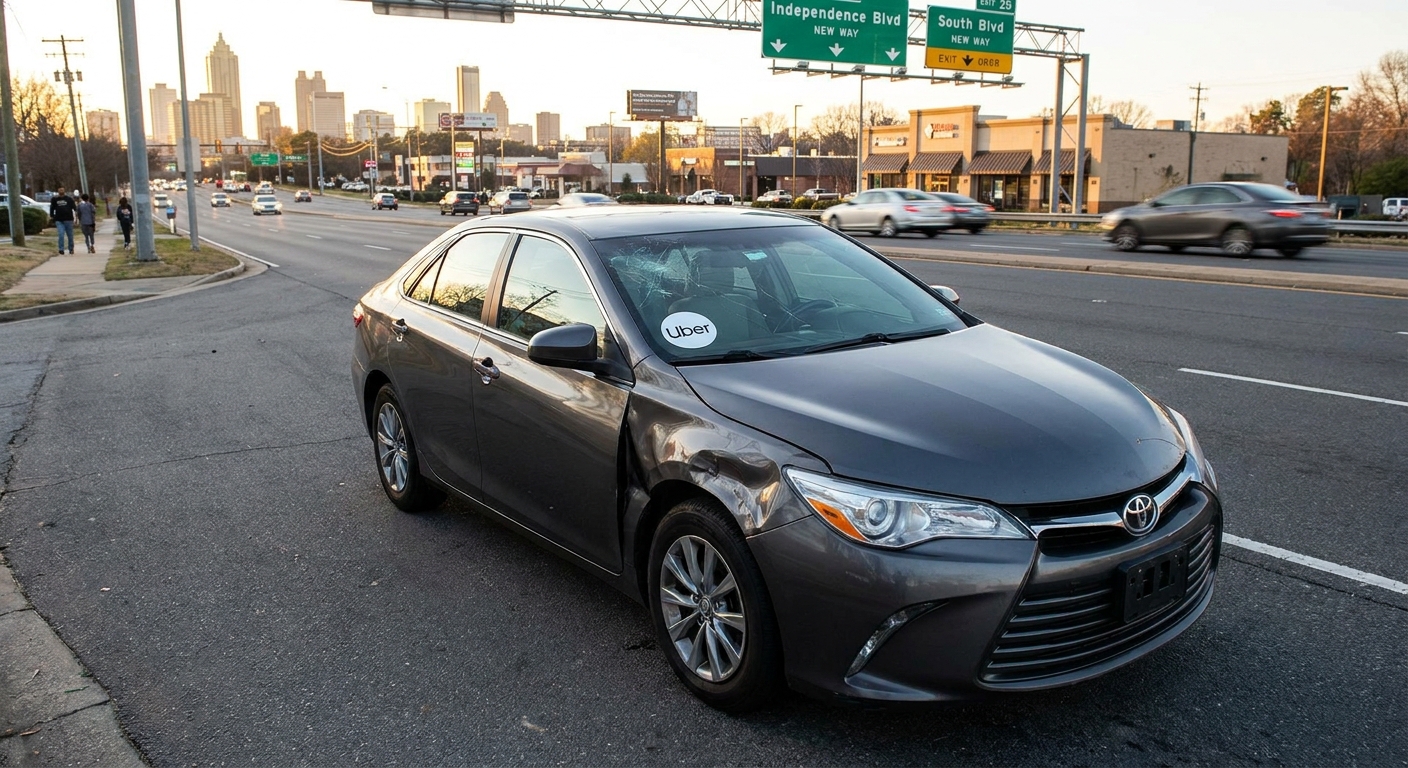
Most of the T-bone crashes that reach my desk at Carma Legal start at four-way intersections controlled by traffic lights. A driver runs a red light, or a driver turning left cuts across oncoming traffic instead of yielding. The impact is different from a rear-end or head-on crash. When you get hit from the side, only a door and a thin sheet of metal sit between you and the other vehicle. That difference shapes everything that follows. T-bone crash injuries often involve harder hits, deeper damage, and longer recoveries, and they often show up in parts of your body you never expected to hurt.
If you were just hit from the side, your neck, lower back, knee, ribs, and head may all be sore at once. You may have a growing stack of missed calls from an adjuster. You may not know which of these injuries matter for your claim, or whether the other driver is already telling a different story about who had the light.
At Carma Legal, I handle injury cases for people in Charlotte, and when you call, you talk to me, the attorney, not a paralegal or an intermediary. This guide covers what a side impact can do to your body, why the physics matter, who is often at fault, how these claims are evaluated, how long they can take, and what to do right now. In North Carolina, the contributory negligence rule can bar your recovery completely if you are found even slightly at fault. That means the way your injuries and the crash get documented in the first days can affect whether you have a claim at all.
What Are the Most Common T Bone Crash Injuries, and Why Does a Side Hit Cause Them?
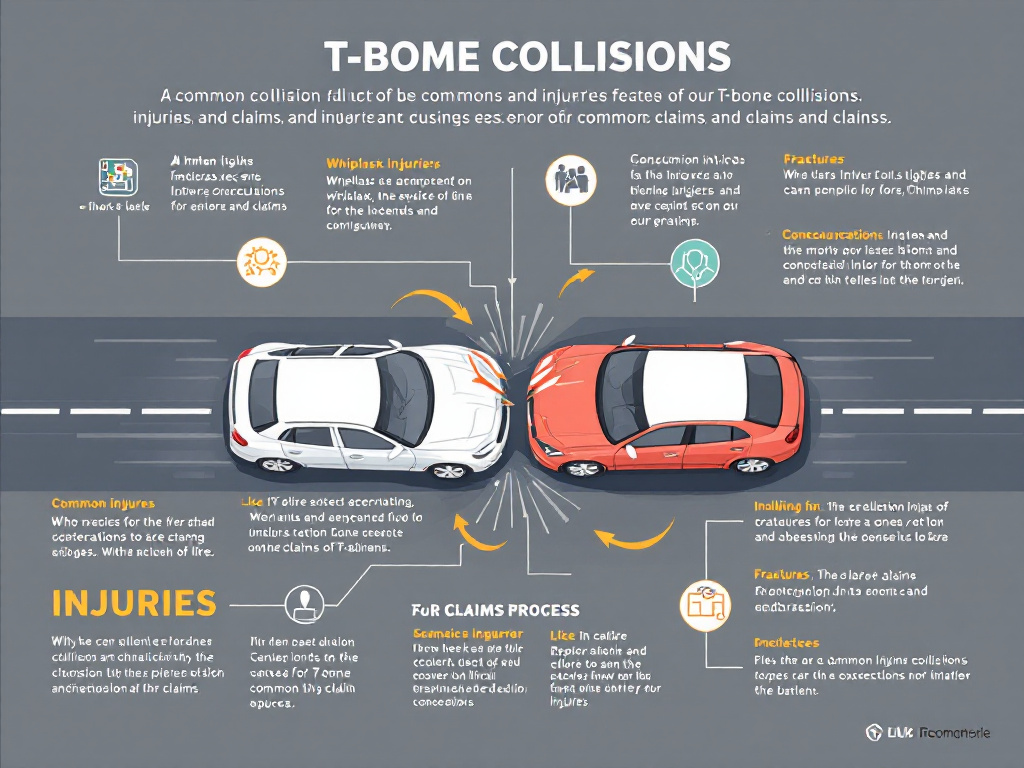
Common T-bone crash injuries include neck (cervical spine) injuries, lower back (lumbar spine) injuries, knee injuries from striking the dashboard, airbag injuries, and head injuries, including concussions, from hitting the side window or the headrest. When the door pushes into the cabin, rib fractures, internal organ damage, and pelvic injuries are also possible.
In the T-bone cases that come to Carma Legal, the same cluster keeps appearing: cervical spine injuries, lumbar spine injuries, knees slamming into the dashboard, harm caused by the airbag deployment itself, and heads striking the side window or snapping back into the headrest hard enough to cause a concussion. Here is how a side impact can produce each one, organized by body region:
- Head and brain. Your head sits inches from the side window and the door frame. In a side hit, your head can move toward the impact and strike the glass or the pillar, then rebound into the headrest. Either blow can cause a concussion or another traumatic brain injury, sometimes without any loss of consciousness.
- Neck (cervical spine). The seatbelt holds your torso, but nothing holds your head. When your car gets shoved sideways, your head can bend sharply to the side, a direction the neck is poorly built to resist. That side-to-side whiplash can strain muscles, stretch ligaments, injure discs, and irritate nerves that send pain or tingling into your shoulder and arm.
- Lower back (lumbar spine). The seat and belt pin your hips while your upper body gets pushed and twisted. That twisting load lands on the spinal discs and joints of your lower back. This is why lumbar pain is common after a side impact, even when the car still looks drivable.
- Chest and ribs. The door panel can intrude into the cabin and strike the side of your chest directly. Ribs on the struck side can crack or break, and a broken rib can bruise or puncture a lung.
- Abdomen and internal organs. There is almost no crush space on the side of a car, so blunt force reaches your torso with little to slow it down. The spleen sits on the left side of the body and the liver on the right. A driver hit on the left or a passenger hit on the right faces possible risk of organ bruising, tearing, or internal bleeding that may not cause obvious symptoms right away.
- Pelvis and hips. The door sits at hip level. When it pushes inward, it can drive into the hip and pelvis, potentially causing fractures of the pelvis or the hip socket.
- Knees and legs. Your body can slide and rotate in the seat during the crash, and your knees can strike the dashboard, the lower dash panel, or the door. That can bruise or fracture the kneecap and damage the ligaments inside the knee.
- Airbag and soft tissue injuries. Side and curtain airbags protect you, but they deploy with enormous force. They can cause abrasions, burns, and bruising to your face, arms, and chest, on top of the sprains and strains that can run through your shoulders and back.
This matters for your claim as much as it matters for your health. The adjuster’s job is to separate your injuries from the crash, which is a fight over causation. A medical record that ties your lower back pain to the sideways twist of a T-bone impact may be harder to dispute than one that just says “back pain.” When I talk with a client, I want to understand how each injury happened. I want to be able to tell my client’s story because I actually know their story.
Why Does a Side Hit Often Do So Much Damage?
Once you see how these injuries happen, the next question is why they tend to be serious. T-bone accidents can be severe because the side of a car has very little structure to absorb crash energy. The force of the other vehicle can pass almost straight into the person sitting closest to the impact. A front end has a bumper, a hood, and an engine bay to crush. The side of your car has a door.
Car makers design the front and rear of a vehicle as crumple zones. Those areas fold up in a controlled way over a long distance, which slows the crash down and spreads the force out before it reaches you. On the side, that distance shrinks to a few inches of door panel, padding, and frame. Your shoulder, hip, and head are right there. A taller vehicle, such as a pickup or SUV, tends to strike higher on the door, closer to your chest and head, which can make things worse.
The numbers reflect that. The Insurance Institute for Highway Safety reports that side impacts account for roughly 23 percent of passenger vehicle occupant deaths, so a side hit can mean not only serious injury but death. NHTSA’s Crash Injury Research Engineering Network, known as CIREN, brings crash engineers and trauma doctors together to study real collisions. Its body of published research is part of why we understand how specific crash forces can turn into specific injuries.
What I see with my own Carma Legal clients lines up with that research. Because the impact can be violent, people hurt in T-bone crashes may come away with injuries that hang on longer. You may also be dealing with a damaged car, a rental, medical bills, and a job you cannot fully do yet. Insurance companies know side impacts can leave victims with serious injuries. That is often why a lowball offer arrives early, before anyone, including you, knows the full extent of the damage.
What Happens to Your Body When You Get T-Boned?
When you get T-boned, your car is shoved sideways faster than your body can follow. The door comes into you, your head whips toward the impact, and then everything rebounds the other way, all in a fraction of a second. Many of the injuries in a T-bone crash come from that sequence, not from a single blow.
Here is how it unfolds. First, the striking vehicle hits your door and pushes it inward. Your car begins moving sideways, but your body is still where it was, so the door panel meets your hip, ribs, and shoulder. Next, your torso gets pushed toward the center of the car while your head lags behind for an instant, then snaps sideways. That side-bending motion is what can stretch and injure the cervical spine. At nearly the same moment, your head may strike the side window or the frame beside it.
Then the side and curtain airbags fire, adding their own force to your face, arm, and chest. Your body slides and twists in the seat, which is when knees hit the dashboard and the lower back takes a rotating load. Finally, everything rebounds, and your head can snap back into the headrest. A concussion can come from the window strike, the rebound, or both. This full chain of forces, not just the first hit, is the kind of injury-mechanism question that NHTSA’s CIREN research centers have studied for years.
Adrenaline hides a lot of this at the scene. In my experience at Carma Legal, the real struggle in these cases is pinning down which injuries the crash actually caused, getting in front of the right physicians to confirm it, and then treating those injuries properly. Do not sweep them under the rug or push them off for later. If you simply live with the pain, you may not be compensated for it. Which doctors you see is your decision, not your attorney’s. In an emergency, you go to the hospital, and urgent care is also an option to rule out emergency injuries and get them handled right away. What comes after that varies with your injuries and a lot of other factors, and that is a conversation we have one on one.
Who Is Often at Fault in a T-Bone Accident?
The driver who violated the right of way is often at fault in a T-bone accident. That frequently means running a red light or turning left in front of oncoming traffic that had the green.
The pattern I see less often, but still regularly, is a driver rolling through a stop sign and pulling out in front of another vehicle. In Charlotte, though, the T-bone cases that come to Carma Legal mostly start at four-way intersections with traffic lights. One driver runs the red, or a driver turning left crosses the path of a car coming the other way when they should have yielded. On paper, fault in these crashes can look obvious. In practice, the other side often has a different version.
This is where North Carolina law gets harsh for T-bone accident victims. North Carolina is one of only a handful of jurisdictions that still follows pure contributory negligence. If the other side proves you contributed to the crash in any degree, even a small one, you can be barred from recovering anything, no matter how badly you were hurt. North Carolina places the burden of proving contributory negligence on the defense (N.C. Gen. Stat. § 1-139). That is exactly why defense attorneys and adjusters work so hard in T-bone cases to put a small piece of the blame on you. Common arguments include “you entered on a yellow that was about to turn red,” “you were going a little fast,” “you should have seen me turning,” and “you were looking at your phone.” North Carolina recognizes some narrow exceptions, such as the last clear chance doctrine, but you never want your case to depend on an exception.
That is why witness statements and police reports matter so much in a Charlotte T-bone case. If the other driver later claims they had the green light when they actually had the red, an independent witness is often what settles it. Avoid arguing fault with the other driver, and do not give the other insurer a recorded statement before you have talked to an attorney.
What Can a Settlement Look Like for T-Bone Accident Injuries?
I will not put a number on your case. What a claim can support comes from your injuries, your treatment, your lost income, and whether the harm is permanent, not from the type of crash. T-bone crashes are often harder impacts, and harder impacts tend to cause more injury and more loss for the person who was hurt. That is the only reason they often carry more weight.
There is no one-to-one rule that says a side impact counts for more than another kind of crash. A T-bone collision that leaves you with a sore shoulder for two weeks is a very different claim from one that leaves you with a herniated cervical disc and months of treatment. In T-bone cases at Carma Legal, I often demand the other driver’s policy limits, because the cervical, lumbar, knee, and head injuries these crashes can produce may justify it. Whether that demand holds up depends on the medical records, the evidence on causation and permanency, your wage loss, the coverage available, and the venue where the case would be tried if it does not settle.
I would rather give you honest guidance than hand you a number on the first call that sounds good and has nothing behind it. No attorney can honestly tell you in a first conversation what your case will settle for. What I can do is build the claim on evidence: your medical records, comparable verdicts and settlements, and a clear picture of how the injury has changed your daily life. When I present it to an adjuster, the message is simple: here are comparable cases, here are the similarities and differences. Then I keep pushing when the adjuster comes back with a lowball offer, through negotiation, mediation, and litigation if it comes to that.
Money is also not the only measure, and I do not like to look at cases that way. When people hire Carma Legal, the priority is often holding the other driver responsible for what they did. Sometimes it is healing and getting the proper care. Sometimes it is simply having your questions answered and the anxiety taken off your shoulders, so someone else navigates the difficult, complex work of seeking compensation for your losses. The result is measured against what you needed when you hired an attorney.
How Long Can T-Bone Accident Injury Claims Take in North Carolina?
T-bone injury claims in North Carolina can take several months to more than a year, depending on the circumstances. The timeline depends on how serious your injuries are, how long treatment lasts, and whether the other side disputes fault under the state’s contributory negligence rule.
The biggest factor is your medical treatment. Settling before you know the full extent of your injuries is one of the most expensive mistakes you can make, because once a claim settles, it is closed. As I said earlier, the struggle is identifying which injuries the crash caused, seeing the right physicians to confirm it, and treating those injuries fully. If you push treatment off, the claim may move faster, but you may not be compensated for the injuries you ignored. A neck injury that needs months of care simply takes longer to document than a bruise.
Fault disputes add time. If the other driver claims you entered on a yellow or failed to yield, the insurer may hold off on any serious offer while it builds a contributory negligence defense. A policy limits demand also takes time, because the insurer reviews everything before responding. If the case goes into litigation, North Carolina superior court civil cases generally go through a mediated settlement conference before trial, which adds its own steps.
There are also deadlines you cannot miss. North Carolina generally gives you three years from the crash to file a personal injury lawsuit (N.C. Gen. Stat. § 1-52).
Because any shared fault can sink a North Carolina claim, the evidence you lock down early can affect the timeline. Photos, the police report, and witness contact information are hard to recreate months later. Intersection camera footage, where it exists, may not be kept long. At Carma Legal, cases are prepared from the beginning as if they will be tried, so the claim does not stall later while someone scrambles to rebuild what happened at the intersection.
What Should You Do Immediately After a T-Bone Crash in Charlotte?
Get medical help first. Then, only if you can do it safely, photograph the scene and the vehicles, call the police for a report, and get contact information from witnesses. If you are too hurt or too shaken to do this, call someone you trust to come and do it for you.
The honest answer depends on how badly you are hurt. In many T-bone crashes, emergency medical teams treat the injured person at the scene and take them straight to the hospital. You may be focused on your health, you may be unconscious, or you may be in an ambulance before you can think about evidence. That is the right priority, and it is common. If you are able to act safely, here is the order that protects both your health and your claim:
- Get medical care. Accept treatment at the scene and go to the hospital if emergency crews recommend it. If you are not transported, get checked at a hospital or urgent care quickly. Hidden injuries such as internal bleeding and concussions do not always announce themselves right away.
- Take pictures. Photograph the intersection, the traffic signals, both vehicles, the point of impact, debris on the road, and any visible injuries.
- Call the police. Ask officers to come out and prepare a police report. In a contributory negligence state, an official record of how the crash happened carries real weight.
- Talk to witnesses. Get names and phone numbers from anyone who saw the crash. If the other driver later says they had the green light when they actually had the red, that witness may be the person who protects your claim.
- Call a loved one. You will likely be in shock, running on adrenaline, or too injured to do any of this yourself. A family member or friend can take the photos and collect the information for you.
- Talk to an attorney before you talk to the other insurer. Contact Carma Legal for direct guidance on what to say, what not to sign, and what to do next.
That last step is where direct access to an attorney matters most. You may be wondering whether you will ever actually talk to a lawyer, or just get passed between staff members. At Carma Legal, you see my face on the website, and when you call, you hear my voice. Many firms grow to the point where clients become file numbers to their lawyers. That is not the firm I want Carma Legal to become. I personally keep in contact with my clients, I manage every part of the case, and communication stays open throughout. I have been doing this a long time, and I can walk you through each step. After a T-bone crash, you have questions about the rental car, the total loss, your medical bills, and the adjuster’s calls. Those are exactly the things I take over and help you resolve.
More Questions People Ask After a T-Bone Crash
Can I still recover compensation if I was partially at fault for a T-bone crash in North Carolina?
Generally, no. North Carolina’s contributory negligence rule can bar any recovery if you contributed to the crash in any degree, even one percent. Narrow exceptions such as the last clear chance doctrine exist, but they are limited. That is why the other side often tries to put a small amount of blame on you, and why strong early evidence matters.
What if my T-bone crash injuries did not show up until days after the collision?
That is common. Internal bleeding, soft tissue damage, and concussions can have delayed symptoms, especially after adrenaline wears off. See a physician right away, describe the crash and your symptoms clearly, and keep records that connect the delayed symptoms to the collision.
How does Carma Legal prove who was at fault in a T-bone intersection crash?
Carma Legal builds fault from the police report, witness statements, intersection camera footage when it exists, the damage pattern on both vehicles, and a reconstruction of the collision sequence that shows who violated the right of way, such as who entered on the red or who turned left without yielding.
What does a consultation with Carma Legal involve for a T-bone crash case?
It is a direct conversation with the attorney, not a paralegal. We review your crash facts, your injuries, your medical treatment so far, and whether North Carolina’s contributory negligence rule affects your claim.
Do I need a lawyer if the other driver’s insurance already admitted fault in my T-bone crash?
An admission helps, but it does not end the dispute. Insurers may accept fault and then minimize how serious your injuries are, or later dispute causation. In North Carolina, they may still raise contributory negligence to reduce or deny the claim.
What if the at-fault driver in my T-bone crash only has minimum insurance coverage?
Your own underinsured motorist coverage may provide additional compensation when the other driver’s policy is not enough. An attorney can review every policy that may apply, including yours, so that no source of coverage is overlooked.
Talk With the Attorney Who Will Actually Handle Your T-Bone Case
If you were injured in a T-bone collision in Charlotte, call Carma Legal at 702-934-2228. You will speak with the attorney who reviews your injuries, your crash facts, and your legal options under North Carolina law. We are very intentional about the cases we take, and you will get honest guidance on whether your claim makes sense to pursue and what it will take. Carma Legal serves injured people from its Charlotte, NC 28273 office, and telehealth-style remote consultations are available if you cannot come in.
Before you make that call, do one thing tonight. Write down every part of your body that hurts, when each one started, and what you could do before the crash that you cannot do now. Do it while the details are fresh. That short list often becomes the backbone of the causation evidence in a T-bone case. It is far easier to write today than to reconstruct months from now, when an adjuster asks why you waited.
Let’s Talk About What Comes Next
T-bone collisions leave you dealing with injuries that complicate every part of your day, and the insurance process often feels like it was designed to wear you down. If you’re wondering whether your case is being handled correctly or if you’re getting the compensation your injuries actually require, a conversation is free and costs you nothing. Carma Legal handles t-bone collision cases in Charlotte and Mesa, and we can walk you through what a proper claim should look like for your specific injuries.
Individual results vary case by case, and outcomes depend on many factors unique to each situation. This article is general information and is not legal advice.